

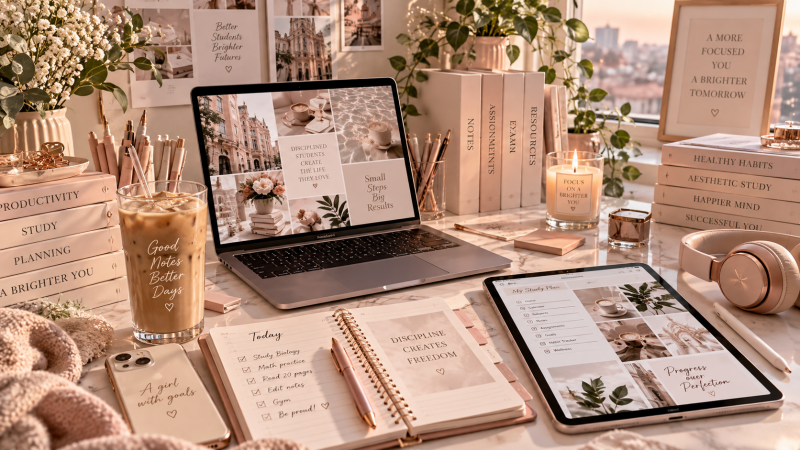
There is a very particular feeling that comes from sitting down at a study space that feels completely put together, when your laptop is open, your notes are exactly where they belong, your planner quietly shows you what matters today, a cup of coffee or matcha is waiting beside you and, instead of being greeted by twenty open tabs, forgotten assignments and a downloads folder you are slightly afraid to look at, everything around you seems to say the same thing: you know what you are doing, you know where to begin and you have created a space that makes you want to stay.
That is the part of aesthetic studying that I love. Not because productivity needs to be pink, perfectly styled or worthy of a Pinterest board, but because there is something powerful about creating an environment that makes everyday responsibilities feel a little more beautiful. Studying takes up so many hours of a student's life that I have never understood why the systems surrounding it should feel cold, complicated or uninspiring. Your digital study space can be beautiful. It can feel calm. It can feel creative and personal. But most importantly, it can actually make studying easier. And that is where we begin.
Create a digital space that feels like coming home
Before thinking about colors, wallpapers, fonts or beautiful digital planners, I would start with something much less exciting but infinitely more important, because the foundation of a good study system is knowing exactly where everything belongs.
Most digital chaos does not happen because we are naturally disorganized. It happens slowly, almost invisibly, because we never decided where things should live in the first place. One lecture arrives as a PDF, another worksheet stays in the downloads folder, an assignment deadline is written in a notebook, an exam date is buried in an email and three weeks later we are searching five different places for something we know we saved somewhere. A beautiful study system should remove that feeling completely.
Imagine opening your laptop and having one central place for your academic life, with your calendar holding your classes, exams and deadlines, your planner holding the things you actually need to accomplish, your notes containing the information you are learning and your folders quietly storing everything else in a structure that makes sense. It does not need to be complicated, because the magic is actually in making it almost boringly obvious.
Create one main folder for your current semester or school year and inside it give every subject its own home. Within each subject, use the same simple structure for notes, assignments, exam preparation and resources, so that after a few weeks you no longer have to consciously think about where a document belongs because the system has become familiar.
Even the way you name your files can change the feeling of your digital space. A folder filled with names such as final2.pdf, document-new.pdf and scan458.pdf creates tiny moments of friction every time you need something, while a file called Biology Chapter 4 Cell Division Notes.pdf tells you exactly what is waiting inside before you even open it. These details seem small until you experience what it feels like when hundreds of small decisions disappear from your day. That is when organization begins to feel like ease.
Let your planner tell you where to go, not give you somewhere else to get lost
There is an easy trap to fall into when you love planning, stationery and beautiful digital tools, because organizing your studying can start to feel so productive that you accidentally spend more time preparing to work than actually working.
You redesign the weekly page. You change the colors. You reorganize the subjects. You create another tracker. You search for a better app. And somehow an hour has disappeared while the assignment is still sitting exactly where it was. A good planner should never become another project you have to maintain. Its purpose is much simpler.
When you open it, it should answer what needs your attention, when it needs to be finished and what you should work on next. Once you know those things, the planner has done its job and you can move into the part that actually changes your results.
The studying. This is also why I love planning around outcomes rather than hours, because there is an enormous difference between writing “Study Biology for two hours” and writing “Understand Chapter Four, create a one page summary and complete twenty practice questions.” The first gives you a period of time to fill. The second gives you somewhere to arrive. Suddenly a study session has a beginning, a purpose and a finish line, which makes it much easier to sit down and start because you are no longer facing the enormous vague task of “studying.”
You know exactly what success looks like today.
Build a weekly view that lets your mind feel quiet
Your weekly study dashboard does not need to contain every detail of your life, every habit you would someday like to develop and seventeen different trackers that you will enthusiastically complete for four days before forgetting they exist.
It needs to give you clarity. I would keep your current deadlines visible, add upcoming exams, choose your three most important academic priorities and keep a small space for assignments that are currently in progress, because those few pieces of information are usually enough to understand what the week is asking from you. Then plan around the life you actually have.
If Wednesday is filled with classes, commuting, work or family responsibilities, do not build a fantasy version of Wednesday in your planner where you somehow wake up at five, study for three hours, attend every class, exercise, cook, revise an entire chapter and finish the evening journaling peacefully beside a candle. Beautiful planning is still realistic planning.
There is something much more satisfying about looking at a week that fits your real life and completing what you intended to do than constantly carrying unfinished tasks into tomorrow because your planner was designed for an imaginary version of you with unlimited energy.
Your system should understand that you are human.
Now make it beautiful
Once the structure works, this is where the fun begins, because your digital study space does not have to look like an office filing cabinet simply because it is functional. Choose colors that make you feel good when you open your screen.
Maybe yours is cream, blush and warm beige with tiny touches of rose gold. Maybe it is sage and soft ivory. Maybe you love dusty blue, deep brown or a beautifully minimal black and white setup. There is no correct aesthetic. The point is to create visual consistency so that your digital world begins to feel intentional rather than accidental.
You might use the same palette for your digital notebook covers, planner pages and desktop wallpaper, choose one elegant font for headings, create simple icons for your subject folders and keep your home screen clean enough that opening your laptop feels peaceful rather than overwhelming. The aesthetic becomes especially beautiful when it has a purpose.
One color might identify deadlines while another marks exams. A small set of icons might help you recognize subjects instantly. Different notebook covers can make it easier to move between courses without reading every title. That is the sweet spot.
Beauty that creates clarity.
Not decoration for the sake of decoration, but a visual system that makes you genuinely enjoy interacting with your academic life. Because when something feels inviting, we naturally resist it a little less.
Make starting feel almost effortless
Sometimes the hardest part of studying is not understanding the material. It is beginning. You sit down, open your laptop, remember that you need a document, notice an email, open another tab, check something on your phone and suddenly your brain is everywhere except the task you originally wanted to complete. A small starting ritual can change that completely.
Before each study session, give yourself a few minutes to prepare your environment. Open your planner, choose one clearly defined task, gather the notes and resources you need, close everything unrelated and move your phone somewhere that it cannot steal your attention every few minutes.
Then begin with one thing. Not the entire semester. Not everything you are behind on. Not every exam coming next month. Just the next thing. There is something deeply calming about reducing a stressful workload to a single visible action, because once you begin moving, the enormous cloud of “everything I need to do” starts turning into individual tasks that can actually be completed.
And every completed task gives you a little more space to breathe.
Create notes for your future self
Beautiful notes are wonderful when creating them helps you engage with what you are learning, but the real test of a good note is whether it helps you later. Imagine yourself two months from now, sitting down before an exam and opening the notes you are making today. Would they help you understand the subject quickly? Could you identify the essential ideas? Could you see what you struggled with? Would you know which concepts deserve another look? That future version of you is the person you are designing your notes for.
After a lecture or study session, instead of simply copying information into prettier boxes, take a moment to ask yourself what the most important ideas were, what you could explain without looking at the page, what still feels confusing and what could realistically become an exam question. Then use your aesthetic elements to make those answers easier to see. Highlight intentionally. Use diagrams when a diagram genuinely explains something better. Leave space around important information. Create small summary sections. Use digital stickers and decorative elements if they make the process enjoyable, but allow the content to remain the star of the page.
The goal is not to create notes everyone else would want to save. The goal is to create notes you will be grateful to open again.
Prepare for exams long before exam season arrives
One of the most peaceful things you can do for your future self is create an exam preparation folder at the beginning of a course rather than at the end. Every time you encounter an important concept, a difficult topic, a useful practice question or a resource that finally explains something clearly, place it there. Over time, without any dramatic effort, you begin building your revision material.
When exam season eventually arrives and everyone suddenly starts searching through months of lectures trying to understand what they are supposed to revise, you already have a curated collection of the material that mattered most. You can add short summaries, practice questions, past papers, topics you struggled with and questions you want to revisit, and the folder quietly grows alongside your knowledge.
This is the kind of organization I love most because it does not demand perfection today.
It simply makes tomorrow easier.
Give your digital world a weekly reset
Even the most beautiful and carefully organized digital system will become a little messy over time, simply because real life rarely follows a perfectly planned schedule. New files find their way into your downloads folder, assignments change, deadlines move, tabs stay open longer than they should and a few unfinished tasks quietly follow you from one day into the next. None of this means that your system is no longer working, because a good system was never meant to remain perfectly organized on its own. Sometimes it simply needs a little attention to feel calm again.
Once a week, turn that little reset into something you genuinely enjoy rather than another task on your list. Make your favorite coffee or matcha, put on music that makes your space feel good, open your laptop and give yourself fifteen quiet minutes to bring everything back into place. Clear the files you no longer need, move important documents into the folders where they belong, look through the deadlines and commitments waiting for you in the coming week, archive the assignments you have already completed and gently move anything unfinished into a realistic place in your new plan. Before you finish, choose the three things that deserve most of your attention next, so that when a new week begins, you already know where you want to go.
There is something surprisingly satisfying about watching digital clutter disappear while doing this, because you are not only closing old tabs and organizing files, you are also giving yourself the chance to notice everything you have already accomplished and to see what is coming before it has the opportunity to become overwhelming. Instead of opening your laptop on Monday with that uncomfortable feeling that something important might be hiding somewhere in the background, you begin with a space that feels clear, a mind that feels lighter and a plan that gives you direction.
It does not need to be a perfect plan. It simply needs to be clear enough to make your next step feel easy.
Your study system should feel like you
Perhaps the most important thing to remember when creating your digital study system is that it should feel like your space, rather than a beautiful version of somebody else’s life that you are constantly trying to recreate. You do not need the study setup that looks perfect in someone else’s video, the morning routine that seems effortless on Pinterest or every new productivity app that promises to organize your entire life, especially when all of those tools eventually leave you feeling more overwhelmed than organized.
Your own system can be beautifully feminine, wonderfully minimal, colorful and creative or completely understated, because there is no single aesthetic that makes someone productive. What matters is that the moment you sit down at your desk and open your laptop, you understand what deserves your attention, you know where to find what you need and your next step feels clear enough that you can simply begin.
When you reach that point, you have created something far more valuable than an aesthetic workspace. You have created an environment that protects your attention and gives your mind somewhere calm to return to, even when school, assignments and everyday life become busy.
And if that environment also happens to be filled with the colors you love, a planner you genuinely enjoy opening, beautifully organized notes, your favorite coffee beside you and a digital space that feels peaceful the moment it appears on your screen, then studying begins to feel different. It becomes a little less like something you are endlessly trying to catch up with and a little more like a part of the life you are intentionally creating for yourself.
For me, that is what a beautiful study aesthetic should really be about. It is not about creating a perfectly styled desk or maintaining an impossibly organized life, but about surrounding yourself with small details that make it easier to focus, easier to begin and perhaps even a little more enjoyable to keep going.
Because the most beautiful study space is not the one that looks perfect. It is the one that feels like yours and has a purpose behind every beautiful detail.
A little something for your next study day
Inside the Dayna Ashfort Studio Free Template Library, you can find printable resources designed to bring a little more structure and beauty into everyday planning, studying and organization, so if you are building your own study system, choose a page that solves one problem you have right now and begin there.
You do not need to organize your entire life tonight.
Sometimes one clear page, one finished task and one beautifully calm corner of your digital world are enough to make tomorrow feel completely different.
Dayna Ashfort
Dayna Ashfort Studio
Kommentar hinzufügen
Kommentare