


Helping your child study at home shouldn’t mean hours of stress, arguments, or searching for the right resources. With a few simple strategies, you can make learning feel more manageable, help your child build confidence, and gradually develop study habits they can use independently.
How to Help Your Child Study at Home Without Pressure or Constant Arguments
Helping your child with schoolwork can be surprisingly difficult. You want them to understand what they are learning, keep up with their class and feel confident at school, but somewhere between unfinished homework, an upcoming test and the sentence “I don’t understand this,” an ordinary afternoon can quickly become stressful for everyone.
Many parents know this situation. Your child brings home a topic they do not fully understand, but you are not quite sure how it was explained at school. Perhaps you learned the same subject differently yourself, it has been years since you last worked with fractions or grammar rules, or your child simply cannot explain which part is causing the problem. You search online for an explanation, open several worksheets, watch a video and eventually realize that you have spent more time trying to find the right learning material than actually helping your child.
Supporting a child at home does not require turning your kitchen table into another classroom. What children often need most is a calm environment, a manageable plan and someone who can help them turn an overwhelming school problem into smaller steps they can actually understand.
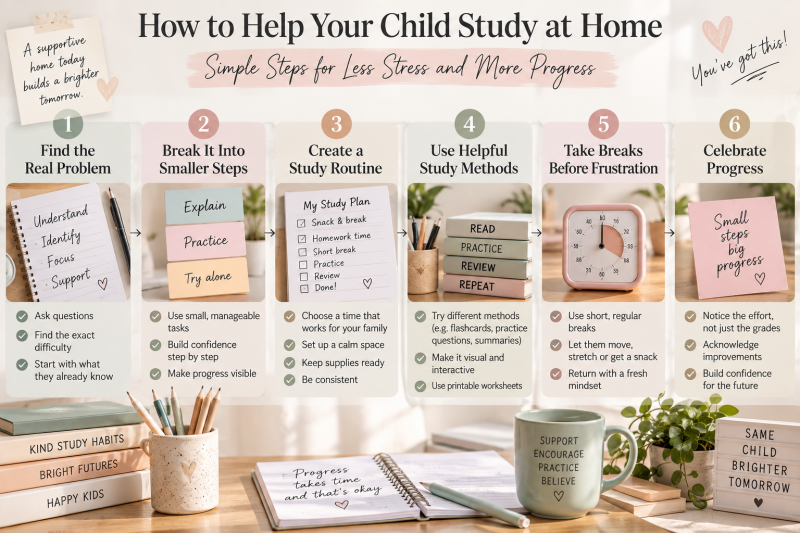
Start by Finding the Real Problem
When a child says, “I don’t understand math,” the problem is usually much more specific than math itself. They may understand multiplication but struggle with word problems. They may know how to calculate an answer but become confused when carrying numbers. They may understand a reading passage but have difficulty explaining what they have read.
Before beginning another worksheet, try to identify the exact point where your child becomes unsure. Ask them to show you one problem they can complete independently and then one that feels difficult. Let them explain what they think they are supposed to do, even if their explanation is incomplete.
This gives you valuable information because it separates what your child already understands from what still needs practice. Instead of spending an hour reviewing an entire chapter, you may discover that there is only one small concept standing in the way.
Children can also become discouraged when every learning session begins with what they are doing wrong. Starting with something they already know gives them an immediate sense of competence before moving toward the harder part.
Make the Task Smaller Before You Make the Study Session Longer
When a child is struggling, the natural response can be to practice more. Sometimes more practice is useful, but a longer study session is not automatically a better one.
Imagine that your child has twenty multiplication problems to complete and already feels overwhelmed. Cover most of the page and begin with three. Work through the first example together, let your child try the second with some guidance and encourage them to complete the third independently.
That progression is simple, but powerful:
Understand it together → practice it together → try it independently.
The same approach works for reading, spelling, writing and many other school subjects. A long reading assignment can become one paragraph followed by two questions. Ten spelling words can become groups of three. A complicated project can become several small tasks spread across the week.
Small tasks make progress visible, and visible progress makes it easier for children to continue.
Create a Study Routine That Feels Predictable
Children often respond better to routines when they know what is expected before they begin. Studying does not need to happen at exactly the same minute every day, but having a familiar rhythm can reduce arguments about when homework will start.
A simple routine might include arriving home, having a snack, taking some time to relax and then beginning homework before the evening becomes too busy. Another child may work better after physical activity or after dinner. The best routine is not necessarily the most aesthetically perfect schedule; it is the one your family can realistically repeat.
The study space matters too, but it does not need to look like something from Pinterest. A clear table, basic supplies, adequate lighting and fewer unnecessary distractions are often enough. Having pencils, paper, a calculator when appropriate and frequently used learning sheets nearby also prevents children from constantly interrupting their concentration to search for something.
Once you find a rhythm that works, consistency can gradually reduce the daily negotiation surrounding homework.
Teach Your Child How to Study, Not Only What to Study
Children are frequently told to “go study,” even though studying itself is a skill they may never have been explicitly taught.
Reading the same page repeatedly is not always the most effective way to learn. Encourage your child to interact with the material instead. They can explain a concept aloud in their own words, create flashcards, answer practice questions without looking at the answers, write down what they remember after reading or teach the topic back to you.
For younger children, learning can be much more visual. Multiplication charts, colored markers, number lines, clocks, word cards and simple printable exercises can turn an abstract concept into something they can see and work with.
Older students can begin learning how to divide their study time between subjects, plan for upcoming tests and identify which topics need the most attention. A study tracker can also help them see that progress comes from repeated focused sessions rather than one exhausting evening before an exam.
The long-term goal is not simply completing tonight’s homework. It is gradually helping your child develop learning strategies they can eventually use without you.
Use Breaks Before Frustration Takes Over
There is a point during some homework sessions when almost nothing productive is happening anymore. Your child is frustrated, you are frustrated and the same question has been explained four different ways. Continuing for another thirty minutes may not solve the problem.
A short break can be far more useful. Let your child get a drink, move around, stretch or step away from the table for a few minutes. When they return, begin with something manageable rather than immediately returning to the most difficult question.
Breaks should not become an escape from every challenging task, but they can prevent ordinary difficulty from becoming a complete emotional shutdown. Learning requires effort, yet productive effort and endless frustration are not the same thing.
Replace “You Should Know This” With Better Questions
The language surrounding learning can influence how children respond to difficulty. A child who repeatedly hears that something is easy may conclude that struggling with it means they are bad at the subject. Instead of focusing immediately on the mistake, ask questions that help your child think.
“What part makes sense to you?”
“Where did you start feeling confused?”
“Can you show me how you got this answer?”
“What could we try next?”
“Do you want me to show you one example first?”
These questions communicate that not knowing something yet is a problem that can be investigated rather than evidence that the child cannot learn it. It also gives you a much clearer picture of what kind of help they actually need.
Let Your Child Do the Thinking
Helping with homework can easily turn into completing homework, especially when everyone is tired and finishing quickly feels tempting. Try to resist that shortcut.
If you immediately provide every answer, your child may finish the worksheet without understanding the concept. Instead, demonstrate one example, think through another together and then let your child attempt the next one.
Give them enough time to think before stepping in. Silence can feel uncomfortable when you already know the answer, but that thinking time is part of learning.
If they make a mistake, ask them to look at their process before simply correcting the final answer. Sometimes children can find their own error when they retrace their steps, and discovering the mistake themselves can be more valuable than being told what went wrong.
Prepare for Tests Before the Night Before
Test preparation becomes much less stressful when it starts early enough to be divided into small sessions. As soon as you know a test is coming, help your child identify what will be covered. Break the material into topics and spread them across several days. Begin with the areas that need the most attention while continuing to review concepts your child already knows.
Practice questions are particularly useful because they reveal whether your child can retrieve information independently rather than simply recognize it while looking at a textbook.
The evening before a test should ideally be used for light review and preparation rather than learning an entire unit from the beginning. Packing the school bag, preparing anything needed for the next morning and getting enough rest can be just as important as squeezing in one more hour of studying.
Notice Progress That Has Nothing to Do With Grades
Grades matter in school, but they are only one measure of learning. Notice when your child begins homework without being reminded five times. Notice when they keep trying after getting an answer wrong. Notice when a multiplication fact that required counting last month can now be answered immediately. Notice when they remember to prepare for a test several days in advance.
These small improvements are evidence that learning skills are developing. Instead of only saying, “You got an A,” you can also say, “You practiced this several times and now you can do it by yourself,” or, “I noticed that you kept working even when that question was difficult.”
This connects success to actions your child can repeat rather than making achievement feel like something they either naturally have or do not have.
Know When Your Child Needs More Support
Not every learning difficulty can or should be solved with another printable worksheet. If your child consistently struggles with a particular skill, becomes extremely distressed about schoolwork or seems unable to make progress despite regular practice, it is worth speaking with their teacher.
Ask specifically what the teacher is observing in class, what skills your child is expected to have at that stage and what type of practice would be most helpful at home. The more specific the conversation becomes, the easier it is to coordinate support.
Additional professional or educational support may sometimes be appropriate as well. Asking for more help does not mean that your efforts at home have failed; it simply means that you are gathering the resources your child needs.
You Do Not Need to Recreate School at Home
One of the most important things to remember is that your home does not need to become a second school. Your role is not to know every answer or perfectly explain every subject. You can help your child create structure, find useful resources, practice difficult skills, ask better questions and discover that confusion does not have to be permanent.
Some days, learning at home will go beautifully. On other days, ten minutes of productive practice may be enough. What matters is creating an environment in which your child learns that difficult things can be broken down, practiced and eventually understood.
Over time, the goal is for your child to need less direction from you because they are developing the confidence and strategies to manage learning themselves.
And perhaps that is one of the most useful things we can teach children: when they do not understand something today, they have tools they can use to understand it tomorrow.
Free Learning Support for Home
If you are looking for simple resources to make learning at home a little easier, explore the Dayna Ashfort Free Printable Library. You can find free printable learning resources for math, reading, spelling, homework organization, study planning and test preparation, along with parent resources designed to help you support your child without spending hours searching for materials.
Start with the How to Help My Child Study printable parent guide, choose the resource that matches the problem your child is working on right now, and take it one small step at a time.
See you in the next edition. ♡
Dayna Ashfort Studio
Create beautifully. Study smarter. Work with intention.
Kommentar hinzufügen
Kommentare