


Creating a study schedule is easy. Following it when assignments pile up, motivation disappears and real life gets in the way is much harder. The solution is not planning every hour more carefully, but building a study routine around your actual time, energy and priorities. In this guide, you’ll learn how to create a realistic study schedule that helps you stay organized, study consistently and make progress without constantly feeling behind.
How to Create a Study Schedule You’ll Actually Stick To
There is a particular kind of frustration that comes from creating a beautiful study schedule on Sunday evening, feeling completely organized and motivated, only to realize by Wednesday that you are already falling behind. You carefully divide your subjects across the week and promise yourself that this time you will stay ahead of every assignment, review your notes regularly and finally stop preparing for exams at the last minute. On paper, everything seems perfectly manageable, but then real life begins.
A chapter you expected to finish quickly takes twice as long as planned, you come home too tired to concentrate, an assignment you had forgotten about suddenly needs your attention or you spend an entire hour trying to understand a topic you thought would take twenty minutes. Before you know it, your carefully planned week no longer resembles the schedule in front of you. Instead of helping you feel organized, the plan begins to feel like another reminder of everything you have not managed to complete.
This is where many students assume that they simply need more discipline, but discipline is often not the real problem. The problem is that most study schedules are created for an ideal version of the week rather than the week you are actually going to experience. They assume that your energy will remain consistent, every task will take exactly as long as expected and nothing unexpected will interrupt your plans.
A useful study schedule needs to work differently. It should still help you on an ordinary Tuesday when you are tired, one subject is taking longer than expected and your motivation is nowhere to be found. Instead of requiring your week to go perfectly, your schedule should be flexible enough to adjust when it does not. Once you start planning around your real time, energy, workload and priorities, studying becomes much easier to manage, and that is where a study schedule finally starts doing what it was supposed to do in the first place.
Stop Planning Your Ideal Week and Start Planning Your Real One
Before deciding when you are going to study, take an honest look at the time that is actually available in your week. Classes, work, commuting, meals, appointments, sports, family responsibilities and sleep already occupy a significant part of your schedule. When you ignore these commitments and immediately start adding study sessions, you often end up planning hours that technically exist on your calendar but are not realistically available for focused studying.
A better approach is to begin with everything that is already fixed and then look at the time that remains. This small change makes your study schedule much more realistic because instead of asking yourself, “How many hours should I study?”, you begin asking the more useful question, “Where can studying realistically fit into my life this week?”
You may notice, for example, that Monday evening appears completely free on your calendar, but after a long day of classes you are usually too tired to concentrate properly. Saturday morning might look less convenient at first, yet it could be the time when your mind is clearer, your surroundings are quieter and studying feels considerably easier. Recognizing these patterns allows you to plan around the way you actually function instead of the way you think a productive student should function.
Your best study time is therefore not necessarily the largest empty space on your calendar. It is the time when you have enough energy and concentration for the type of work you want to complete. Once you begin treating your energy as part of your schedule rather than focusing only on available hours, your study plan becomes far more realistic and much easier to maintain.
Separate What You Need to Do From When You Will Do It
One of the most common planning mistakes is creating a study schedule before you have a clear picture of your actual workload. Before assigning anything to a particular day or time, first collect everything that currently needs your attention in one place. This includes upcoming assignments, reading, revision, projects, tests, lectures you need to review and any tasks you may already have been postponing. Seeing everything together gives you a much more realistic understanding of what your week actually requires.
Once you have that overview, start thinking about both urgency and importance. An assignment due tomorrow will naturally need your attention before an exam that is still three weeks away, but the closest deadline should not automatically receive all of your study time. A difficult exam may require several weeks of preparation, while an assignment due much sooner could take only thirty minutes to complete. If you only focus on what is urgent today, important tasks that still seem far away continue to move closer until they suddenly become urgent as well.
This is how many students unintentionally create the feeling that they are always catching up. They spend their time responding to the next deadline instead of preparing for what they already know is coming. A realistic study schedule should make room for both. It should help you complete the tasks that need immediate attention while also giving you small, manageable opportunities to prepare for future exams, projects and deadlines.
When you begin working this way, studying becomes less reactive. Instead of repeatedly waiting until something becomes stressful enough to demand your attention, you start making progress before the pressure arrives. Over time, this simple shift can turn your study schedule from a list of approaching deadlines into a system that actually helps you stay ahead.
Turn Vague Study Goals Into Specific Actions
One of the easiest ways to make a study schedule more effective is to stop planning subjects and start planning specific actions. Writing “Study biology”, “Work on math” or “Prepare for exam” may look like a plan, but these tasks are still too vague. When the study session begins, you first have to decide what studying biology actually means, which chapter to open, what material to review and how much you want to complete. That extra decision making creates unnecessary friction before you have even started.
Instead, turn every general study goal into a clear and manageable action. Rather than writing “Study biology,” you could plan to “Read pages 42 to 55, summarize the chapter on cell division and complete ten practice questions.” Suddenly, the task has a clear starting point, a specific purpose and a visible finish line. You know exactly what to do when you sit down, and you also know when the study session has been successfully completed.
This matters because procrastination often begins before the actual work does. When a task feels large, unclear or undefined, starting requires more mental effort. You open your notes, look at several chapters, assignments and unfinished exercises, and spend the first ten minutes trying to decide what deserves your attention. The more decisions you need to make in that moment, the easier it becomes to delay starting altogether.
A specific study schedule removes those decisions in advance. Instead of writing “Chemistry,” write “Review yesterday’s chemistry notes and complete questions 1 to 15.” Instead of writing “Essay,” plan to “Find three reliable sources and write the introduction.” Each study session should tell you exactly what your next action is rather than simply reminding you which subject needs attention.
When you plan this way, you are doing more than organizing your time. You are making studying easier for your future self. Instead of sitting down and asking, “What should I work on?”, you can simply open your schedule and begin. That small difference can significantly reduce procrastination and turn a study plan from a collection of good intentions into a practical system you can actually follow.
Plan Study Sessions Around Your Energy, Not Just Your Clock
Not every available hour in your day is equally useful for studying. There are times when you can concentrate deeply, understand difficult concepts quickly and work through challenging material without much resistance. At other times, even reading the same paragraph several times can feel exhausting. Instead of ignoring these differences and expecting yourself to perform at the same level throughout the entire day, use them to build a study schedule that works with your natural energy.
Try to identify the periods when your concentration is usually strongest and reserve them for the tasks that require the most mental effort. Problem solving, essay writing, memorization, practice exams and learning unfamiliar concepts are much easier to manage when your mind is alert. During periods when your energy is lower, choose lighter tasks such as organizing notes, reviewing flashcards, watching recorded lectures, formatting assignments or preparing your study materials for the following day. You are still making progress, but you are matching the difficulty of the task to the amount of concentration you realistically have available.
Imagine that you have two free hours after school, but you already know that your concentration drops significantly after the first hour. Scheduling two difficult subjects back to back may look productive on paper, but there is a good chance that the second hour will be frustrating and inefficient. A better approach would be to use your first hour for learning new material or completing challenging practice questions, then use the second hour to review familiar concepts, organize your notes or prepare for tomorrow.
The amount of available time has not changed, but the quality of your plan has. Once you begin scheduling according to both time and energy, you stop expecting every study hour to produce the same result. Instead, you give difficult work your best attention and use lower energy periods for tasks that still move you forward. This makes your schedule not only more productive, but also much easier to maintain over time.
Stop Filling Every Available Hour
When you have a long list of things to study, leaving empty space in your schedule can feel almost irresponsible. If you have four free hours, the natural reaction is to fill all four with assignments, revision and study sessions because an entirely planned day looks productive. In reality, however, a schedule with no breathing room is often the easiest kind of schedule to fall behind on.
The problem is that studying rarely happens exactly according to plan. A chapter may take longer to understand than expected, an assignment might require additional research or you may discover during revision that a topic needs much more attention than you originally thought. Real life can also interrupt your plans with appointments, family responsibilities, unexpected deadlines or simply a day when your concentration is not as strong as usual. When every available hour has already been assigned to something, even a small delay has nowhere to go. One unfinished task moves into the next study session, the next task gets pushed back and suddenly an entire week feels behind because one afternoon did not go according to plan.
This is why buffer time should be an intentional part of your study schedule rather than something you add only when everything else is finished. If you expect an assignment to take an hour, avoid creating a plan that depends on it being completed in exactly sixty minutes. Give yourself some flexibility between demanding tasks and, if possible, keep one study block during the week partially unassigned. That time can become your recovery space for unfinished assignments, unexpected tasks, additional revision or a topic that turned out to be more difficult than expected.
If everything goes according to plan and you do not need that buffer, you have gained something valuable rather than wasted time. You can use it to review material, prepare for the following week, work ahead or simply give yourself time to rest without feeling guilty.
Empty space therefore does not make your study schedule less productive. It makes the schedule more resilient. Instead of creating a plan that only works when your week goes perfectly, you are creating one that has enough flexibility to keep working when real life inevitably changes the plan.
Give Every Study Session a Finish Line
A study session becomes much easier to manage when you know not only when you are going to start, but also what needs to happen before you can consider it finished. Many students sit down with a general goal such as “I need to study chemistry tonight,” but that goal has no clear ending. You could study for thirty minutes or continue for three hours and still close your books feeling as though you should have done more. Over time, this can make studying feel endless because there is never a clear moment when you have successfully completed what you planned to do.
Instead, decide what completion will look like before each study session begins. Rather than simply scheduling chemistry for the evening, you might plan to review two lecture sections, complete fifteen practice questions and mark every concept you still do not understand. Once those actions are finished, the session has achieved its purpose. You have created a clear finish line that tells you when the work you planned for that day is complete.
This approach can also make studying feel more motivating because progress becomes visible. Instead of measuring success by how long you managed to sit at your desk, you can measure it by what you actually accomplished. Finishing a chapter, completing a set of practice questions or understanding a difficult concept gives the study session a specific result and makes it easier to recognize that you are moving forward.
Clear finish lines also teach you something important about the way you study. If you repeatedly schedule fifteen practice questions for a forty five minute session but discover that they usually take ninety minutes, that is valuable information. Instead of assuming you are studying too slowly or becoming frustrated with yourself, you can use what you learned to make your next schedule more realistic.
Over time, your estimates become more accurate because they are based on your actual experience rather than assumptions about how long something should take. That is what good study planning is really about. You do not need to predict every week perfectly. You need a system that helps you notice what works, learn from what does not and make the next plan a little better than the last one.
Use a Minimum Version for Difficult Days
One of the most useful things you can build into a study schedule is a smaller version of your routine for the days when following the original plan simply is not realistic. Some days you will be tired, overwhelmed, busy or unable to concentrate as well as usual. If your schedule only counts a full study session as success, those difficult days can quickly turn into days when you do nothing at all.
Instead, decide in advance what the minimum version of your study routine will look like. If your normal plan is to study for two hours, your minimum version might be twenty minutes of focused review. If you normally aim to complete thirty practice questions, your minimum could be five. If you planned to revise an entire chapter but your concentration is low, you might review one section and write down the concepts you still need to revisit.
The purpose of this minimum is not to lower your expectations or replace your normal study sessions. It is there for the days when the realistic alternative would be doing nothing. Twenty focused minutes may not accomplish everything you originally planned, but they keep you connected to your routine and allow you to make at least some progress instead of abandoning the day completely.
This also helps prevent the all or nothing thinking that can quietly destroy a good study routine. Missing one ambitious study session does not mean that you have ruined the week, fallen behind forever or need to start again on Monday. You simply adjust the session to what you can realistically manage that day and continue with your schedule afterward.
Over time, this flexibility can make consistency much easier. A sustainable study routine is not built by performing perfectly every day. It is built by knowing how to continue even when you cannot give your usual amount of time or energy. When success is allowed to have more than one size, a difficult day no longer has the power to turn into a completely lost week.
Build Your Schedule Around Priorities, Not Guilt
There will almost always be more you could study than you realistically have time to complete. Another chapter could be reviewed, more practice questions could be answered and there is usually an assignment, lecture or exam somewhere in the future that you could already be preparing for. When everything feels important at the same time, it becomes very easy to finish a productive day and still feel as though you have not done enough.
This is why your study schedule needs clear priorities. At the beginning of each week, identify the three academic outcomes that would make the biggest difference if you completed them. Perhaps you need to finish an important paper, prepare for an upcoming biology exam and catch up on two mathematics lectures you missed. These three outcomes become the anchors of your week and help you decide where your best time and attention should go first.
This does not mean that every other task becomes unimportant. Smaller assignments, reading, revision and everyday responsibilities still need space in your schedule. The difference is that when your week becomes busier than expected, you already know which tasks should receive your attention first. Instead of looking at a long list and trying to decide what deserves your limited time, your priorities have already made that decision clearer.
Without this hierarchy, every unfinished task can begin to feel equally urgent. You might complete several meaningful study sessions and still end the day thinking about everything that remains undone. That feeling creates unnecessary guilt because your attention stays focused on the length of your remaining list rather than the progress you have actually made.
A useful study schedule should therefore do more than show you everything you could possibly accomplish. It should help you decide what matters most right now. When your priorities are clear, you can make deliberate choices about your time, recognize meaningful progress and finish a study day knowing that even if everything was not completed, the work that mattered most received your attention.
Stop Measuring Productivity Only in Hours
It is easy to assume that a productive study day can be measured by the number of hours you spent studying, but time alone does not tell you very much about the quality of your work. Studying for four hours may sound impressive, yet those four hours are only valuable if they helped you understand something, complete something or move closer to an academic goal. Instead of asking only “How long did I study today?”, start asking “What changed because I studied today?”
Perhaps you finally understood a concept that confused you yesterday, completed an important chapter, solved twenty practice problems, finished an assignment or discovered which topics still need more revision before an exam. These are meaningful signs of progress because they show what your study time actually produced. Even identifying what you do not yet understand can be valuable because it gives your next study session a clearer direction.
Tracking your study time can still be useful, especially when you are trying to build consistency. The important difference is that those hours should represent focused and meaningful work rather than simply time spent sitting at your desk with your books open. One focused hour in which you actively solve problems, review difficult material and test your understanding can often be more valuable than several distracted hours of repeatedly reading the same notes.
This is also why a simple visual study tracker can be surprisingly motivating. When you color one circle after completing a focused study hour, something that normally feels invisible suddenly becomes visible. Instead of relying on motivation or trying to remember how much effort you have invested, you can actually see your consistency building across the page.
One completed circle may not feel significant on its own, but then another appears beside it, followed by another. After several weeks, thirty colored circles no longer represent thirty small study sessions. They represent thirty moments when you sat down, focused and moved yourself forward. That visible evidence of progress can be much more motivating than simply counting hours because it reminds you that meaningful results are rarely created in one enormous effort. They are usually built one focused session at a time.
Review Your Schedule Instead of Judging Yourself
At the end of the week, resist the temptation to look at your study schedule and judge your success only by how closely you followed the original plan. A schedule is not a test that you either pass or fail. It is a tool, and one of its most useful purposes is showing you what actually works for you. Instead of asking “Did I follow my schedule perfectly?”, ask yourself “What did this week teach me about the way I study?”
Look at the study sessions that went well and try to understand why. Notice which sessions you repeatedly postponed, which tasks took longer than expected and when concentrating felt easiest. Think about what interrupted your plans, whether you gave yourself enough recovery time and whether the amount of work you scheduled was realistic in the first place. These questions turn an imperfect week into useful information that can make the following week considerably better.
Perhaps you notice that every study session you scheduled for 9 p.m. was either postponed or completed with very little concentration. Instead of interpreting that as a lack of discipline, use the information. Stop scheduling your most difficult work at that time and move it to a period when your concentration is stronger. Maybe you discover that reading assignments consistently take twice as long as you expect. Rather than rushing through them every week, give them larger study blocks in your next schedule. You might even realize that you can concentrate much better in the library than at home, which tells you where your most demanding study sessions should happen.
The more often you review your schedule this way, the more personalized it becomes. You begin learning how long different tasks actually take, which environments help you focus, when your energy is strongest and how much work you can realistically manage in one week. Your schedule gradually stops being based on assumptions about how you think you should study and starts reflecting the way you actually study best.
That is the real purpose of reviewing your week. You are not trying to become better at obeying a calendar. You are using each week to build a calendar that understands you better. When something repeatedly does not work, you do not need to judge yourself for it. You need to change the plan.
A Simple Weekly Study Schedule You Can Start With
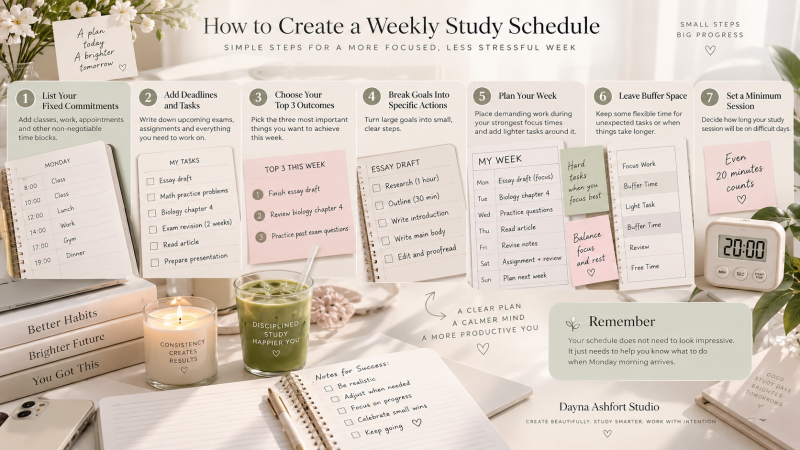
You do not need a complicated productivity system, multiple apps or a perfectly designed planner to create a study schedule that works. In fact, the simpler your system is, the more likely you are to continue using it. Set aside fifteen to twenty minutes once a week to look at what is coming and decide how your available time should be used before the week becomes busy.
Start by adding the commitments that are already fixed, such as classes, work, appointments and other responsibilities. Once you can see the time that genuinely remains, write down your upcoming deadlines, exams, assignments, revision and any academic tasks that currently need your attention. From that list, choose the three outcomes that would make the biggest difference if you completed them during the week. These priorities become the foundation of your schedule.
Next, turn larger goals into specific actions that you can realistically complete during individual study sessions. Instead of scheduling an entire subject, decide exactly what you want to accomplish. Then place the most demanding tasks during the periods when your concentration is usually strongest and use lower energy periods for shorter or lighter activities such as reviewing notes, organizing materials or working through flashcards.
As you build the week, resist the urge to fill every available hour. Leave some buffer space for tasks that take longer than expected, unexpected assignments or anything that needs additional attention. At the same time, decide what your minimum study session will look like on difficult days. Knowing in advance that twenty minutes of focused review still counts as progress makes it much easier to continue your routine when the original plan becomes unrealistic.
Once those pieces are in place, your schedule is finished. It does not need to look impressive, perfectly balanced or aesthetically organized. Its purpose is much simpler. When Monday morning arrives, you should be able to look at your plan and know what matters, when you are going to work on it and exactly what your next step is.
A good weekly study schedule removes decisions from an already busy week. Instead of repeatedly asking yourself “What should I study now?”, you can use that energy for the thing that actually matters: sitting down and beginning.
The Schedule Should Make Studying Feel Smaller
The real purpose of a study schedule is not to fill every available hour of your week or make your calendar look perfectly productive. Its purpose is to remove uncertainty and make a large academic workload feel smaller, clearer and easier to manage. Instead of carrying an entire semester of assignments, exams, chapters and unfinished tasks around in your head, you should be able to look at today and know exactly what deserves your attention.
You do not need to worry about finishing an entire textbook when tonight’s plan is simply to review pages 42 to 55. You do not need to panic every time you think about an exam that is still three weeks away when your first revision session is already scheduled. You also do not need to spend every free moment wondering whether you should be studying because you have already decided when studying will happen and what you are going to work on when that time arrives.
This is what a useful study schedule gives you: fewer decisions, less uncertainty and a clear next step. A workload that once felt overwhelming becomes a series of smaller actions that you can complete one at a time. Instead of constantly thinking about everything that still needs to be done, you can focus on the task directly in front of you and trust that the rest already has a place in your plan.
Of course, some weeks will not go according to schedule. An assignment will take longer than expected, your energy will be lower than usual or something unexpected will change the time you thought you had available. When that happens, the goal is not to abandon the entire schedule because one part of it no longer works. You adjust it, move what needs to be moved and continue from where you are.
That flexibility is what separates a schedule that simply looks productive from one that can genuinely support you throughout a busy semester. You are not trying to create the perfect week. You are creating a system that helps you know what to do next, even when the week becomes imperfect.
The best study schedule is not the one you follow perfectly. It is the one that still works when your week does not.
Ready to Make Studying Feel a Little Easier?
A better study routine does not need to begin with a complicated system. Sometimes it starts with one simple page that helps you see what matters, organize what is coming and turn an overwhelming week into manageable next steps.
Visit the Dayna Ashfort Studio Free Printable Library to find free study and organization worksheets you can download and start using right away. If you are ready to build a more complete system, explore the Dayna Ashfort Studio Shop for printable planner bundles designed to help you plan, study, organize and stay consistent without making life more complicated.
Start with what you need today. Build your system one page at a time.
See you in the next edition. ♡
Dayna Ashfort Studio
Create beautifully. Study smarter. Work with intention.
Kommentar hinzufügen
Kommentare