


Studying is often not difficult because you do not know what to do. The hardest part is simply getting started. When assignments pile up, exams get closer and your study list keeps growing, even opening your notes can begin to feel overwhelming. This guide will help you understand why study procrastination happens and show you a simple, practical system for breaking the cycle, reducing distractions and making it easier to begin even when you do not feel motivated.
How to Stop Procrastinating While Studying: A Simple System to Actually Start
You know you need to study. Your notes are ready, the exam date is getting closer, and somewhere in the back of your mind you keep thinking about everything you should already have finished. You may even have created a study schedule, organized your desk or written a perfectly reasonable to do list. Still, somehow, you do not start.
Instead, you answer one more message, reorganize something that did not really need reorganizing, watch a few videos, make another coffee or convince yourself that you will begin as soon as you feel a little more focused. Before you realize it, an hour has disappeared, and sometimes another one follows.
By the time you finally sit down to study, the work feels even heavier than it did before. Now you are not only dealing with the material itself, but also with the frustration of knowing that you have been avoiding it. This is what makes study procrastination so difficult. The longer you wait to begin, the bigger and more uncomfortable the task can start to feel.
The solution is not necessarily to become more disciplined, create an even stricter schedule or wait until motivation suddenly appears. Often, the most effective change is much smaller. Instead of trying to make yourself study harder, you need to make starting easier.
This guide will show you how to do exactly that. You will learn why procrastination happens before a study session even begins, how to reduce the mental weight of an overwhelming workload and how to use a simple 10 Minute Study Start to move from avoidance into action. The goal is not to become perfectly productive every day, but to build a study system that makes it easier to begin, regain focus and return to your work when motivation is low.
Why You Procrastinate Even When Studying Matters to You
One of the most frustrating things about procrastination is how irrational it can seem. You care about the exam, you want good results and you know that studying earlier would make the days ahead much easier. You may even genuinely want to become someone who studies consistently, stays organized and feels prepared instead of constantly trying to catch up. Yet when it is finally time to begin, you still find yourself avoiding the work.
The reason is that knowing something is important and feeling ready to begin it are two very different things. Procrastination often appears when a task is connected to some form of discomfort. An assignment may feel too large, you may be unsure where to begin, the material may seem difficult or you may already feel so far behind that starting reminds you of everything you have not completed yet.
There is also a difference between immediate and delayed rewards. Checking social media, watching a video or doing something easier can give you an instant sense of distraction or relief, while the benefit of finishing a chapter or preparing properly for an exam may not become visible until days or even weeks later. When studying already feels uncomfortable, the easier option can naturally become more tempting.
This is why treating procrastination simply as a lack of discipline is rarely helpful. If every study session begins with pressure, uncertainty and an overwhelming list of unfinished work, repeatedly telling yourself to try harder does not solve the problem that is making you avoid the task in the first place.
Instead, ask yourself a more useful question: What is making this particular study session difficult to start? Perhaps the task is too large, the next step is unclear, you are distracted, you are tired or you are putting pressure on yourself to accomplish too much at once. Once you identify the source of that resistance, you can begin changing the way you approach the task instead of simply fighting against the feeling of not wanting to start.
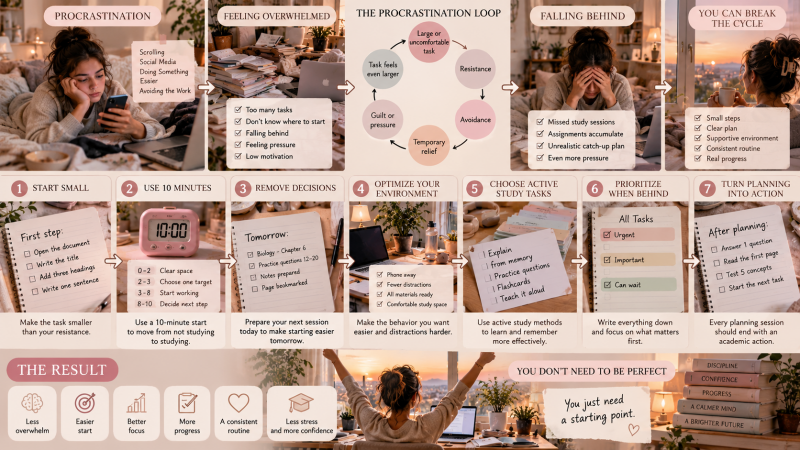
The Procrastination Loop
Study procrastination often follows a surprisingly predictable pattern. You think about studying, but instead of seeing one manageable task, you immediately picture everything that still needs to be done. There are three chapters to read, dozens of flashcards to review, an unfinished assignment waiting for you and an exam that suddenly feels much closer than it did yesterday. What began as a simple intention to study quickly turns into the feeling that you need to deal with everything at once.
That feeling creates discomfort and resistance. Rather than facing the entire workload, you naturally look for something easier to do. You check your phone, watch a video, answer messages or find another small task that suddenly seems important. For a short moment, avoiding studying feels better because the pressure disappears from your immediate attention.
The problem is that the work itself has not disappeared. When you return to it later, you usually have less time available and more pressure than before. The chapters are still waiting, the assignment is still unfinished and the exam is now even closer. As the task begins to feel heavier, the temptation to avoid it can become even stronger.
This creates a repeating cycle in which an overwhelming task creates resistance, resistance leads to avoidance, avoidance provides temporary relief, and that relief is eventually replaced by guilt and additional pressure. The increased pressure then makes the original task feel even more difficult to approach, which can send you straight back into avoidance.
Understanding this pattern is important because it shows why simply telling yourself to stop procrastinating is often not enough. The goal is not to force yourself to complete an entire workload the moment you feel overwhelmed. Instead, you need to interrupt the cycle before avoidance takes over by making the first step small, clear and manageable.
Once starting no longer feels like committing to everything at once, it becomes much easier to move from thinking about studying to actually doing it.
Stop Trying to Start the Entire Study Session
One of the easiest ways to make studying feel overwhelming is to think about the entire study session before you have even started. Imagine opening your schedule and seeing the instruction, “Study biology for three hours.” Technically, you have created a plan, but you have not actually decided what you are going to do.
Do you begin by reading the next chapter, reviewing yesterday’s notes, making flashcards or answering practice questions? Before any studying can happen, you first have to make several decisions. When you are already tired, distracted or struggling with procrastination, those extra decisions can make the study session feel much bigger than it needs to be.
Now imagine that your schedule says, “Open Chapter 6 and answer questions 1 to 5.” The workload itself may not have changed, but your starting point has. You no longer need to figure out how to begin because the first action has already been decided for you.
This distinction matters because many students organize their study plans around subjects or blocks of time rather than specific actions. Instructions such as “study chemistry,” “work on history” or “revise for finals” describe what you intend to accomplish, but they do not tell you what to physically do when you sit down at your desk.
A more effective approach is to decide on your first study action before the session begins. Instead of writing “study math,” decide that you will open the practice sheet and solve the first three equations. Instead of planning to “revise psychology,” decide that you will take out your flashcards and test yourself on Chapter 4. Rather than writing “work on essay,” make your first task opening the document and creating three headings for the next section.
This small change removes an important source of friction. When tomorrow’s study session begins, you are not staring at an entire subject and wondering where to start. You already know the first thing you need to do.
The easier it is to identify that first action, the less time and mental energy you have to spend negotiating with yourself before you begin. You are no longer trying to start an entire three hour study session. You are simply opening Chapter 6 and answering the first question.
The 10-Minute Study Start
This is where the system becomes intentionally simple. When you notice that you are procrastinating, do not try to convince yourself that you are about to have an incredibly productive evening or that you need to study for the next three hours. Instead, commit to just ten minutes.
The purpose of those ten minutes is not to finish an assignment, master an entire chapter or catch up on everything you have postponed. Your only goal is to make the transition from not studying to studying. Once you remove the expectation that starting means committing to hours of work, the task can immediately feel more manageable.
Minute 0–2: Clear Your Starting Space
Spend the first two minutes creating enough space to work comfortably. You do not need to clean your entire room, reorganize your desk or create the perfect study environment. Simply remove the things that are directly distracting you, collect the materials you need and place your phone somewhere where it will not constantly compete for your attention.
Be careful not to turn preparation into another form of procrastination. Your desk does not need to look perfect before you are allowed to study. It only needs to be functional enough for you to begin.
Minute 2–3: Choose One Clear Target
Next, decide on one specific thing you are going to work on. Instead of thinking about everything that needs to happen today, ask yourself, “What is one concrete task I can work on right now?”
Your answer might be to read pages 42 to 47 and write down five key points, complete the first five practice questions or review ten flashcards from yesterday’s lecture. A target like this is much easier to approach than something vague and overwhelming such as “catch up on biology.”
The best starting task is small enough to understand immediately and specific enough that you will know when you have completed it.
Minute 3–8: Begin Before You Feel Ready
For the next five minutes, begin working on the task you selected. Read the first page, answer the first question, review the first few flashcards or write the first paragraph. At this stage, you do not need to decide whether you feel motivated enough to continue for an hour. You only need to perform the action you have already chosen.
This is where many students unintentionally make studying harder. They wait for motivation to arrive before beginning, assuming that they first need to feel focused, productive or ready. In reality, action can create its own momentum. Once your book is open, your document is loaded and your attention has shifted toward the material, continuing can feel considerably easier than starting did a few minutes earlier.
Minute 8–10: Decide What Happens Next
When the ten minutes are almost over, pause briefly and decide what should happen next. If you have found your rhythm and your concentration feels stronger, continue studying. You might set another focused study block, finish the section you started or move directly to the next clearly defined task.
If you are genuinely exhausted or struggling to concentrate, you can choose a short planned break and decide exactly when you will return. Even then, the ten minutes have not been wasted. You have opened the material, identified your current position, completed some real work and reduced some of the uncertainty that was making the task difficult to approach.
Ten minutes alone will not prepare you for an entire exam, and this method is not intended to pretend otherwise. Its purpose is much more specific. The 10-Minute Study Start helps reduce the barrier between knowing that you should study and actually beginning.
Once that barrier has been crossed, the next twenty, thirty or sixty minutes often become much easier to approach.
Make the Task Smaller Than Your Resistance
When you notice yourself avoiding a study task, one of the most effective things you can do is make the task smaller until the first step feels manageable. The goal is not to reduce the importance of the work or convince yourself that a large assignment can be completed in a few minutes. Instead, you are reducing the size of the action required to begin.
If “write the essay” feels impossible, start by opening the document. If even that thought still carries the weight of the entire assignment, focus only on writing the title. Once the title is there, create three headings. Then add one sentence beneath the first heading. With each small action, you move a little further away from avoidance and a little closer to actually working.
This does not mean that every assignment should be completed through tiny fragments. Meaningful studying still requires longer periods of concentration, and difficult projects often need sustained effort. The smaller action simply gives you an entry point when the full task feels too overwhelming to approach.
Think of that first step as a doorway into the work. You do not need to carry the entire assignment through the doorway at once. You only need to enter. Once you are inside the task, have your materials open and know what you are working on, continuing often becomes much easier than beginning was.
Remove Decisions Before the Study Session Begins
Another way to make starting easier is to reduce the number of decisions you need to make when it is time to study. A study session can become surprisingly complicated before any actual learning has happened. You need to decide where to study, which subject to begin with, which chapter to review, where your notes are, whether you should make flashcards, how long you should work and whether you need to watch the lecture before doing anything else.
Individually, these decisions seem small, but together they create unnecessary friction. Every unanswered question gives you another opportunity to delay the moment when you actually begin.
Instead of making all of those decisions at the beginning of tomorrow’s study session, make the most important ones while you are finishing today’s. Spend two minutes deciding exactly where you will continue and leave yourself a simple instruction such as, “Tomorrow: Biology, Chapter 6, practice questions 12 to 20.”
Then prepare whatever you can in advance. Put the relevant materials together, bookmark the page you need, save the correct document and write down exactly where you stopped. When you return, you should be able to understand within seconds what your next action is.
Your future self should not have to reconstruct yesterday’s study session before being able to start today’s. The less preparation and decision making required at the beginning, the easier it becomes to move directly into the work.
A good study system therefore does more than organize your workload. It removes unnecessary decisions from the moments when your motivation may already be low and creates a clear path back into your work.
Use Your Environment as Part of the System
Willpower can help you begin studying, but relying on it to resist distractions throughout every study session makes concentration unnecessarily difficult. Your environment has a powerful influence on how easy it is to stay focused, which means that small changes to your surroundings can remove some of the friction before it becomes a problem.
If your phone repeatedly pulls your attention away, for example, do not spend an entire study session trying to resist checking it. Place it somewhere less accessible, turn off unnecessary notifications or use a focus setting that limits interruptions while you work. If you regularly lose time searching for notebooks, chargers, textbooks or other materials, create one consistent place where your most frequently used study resources are kept.
The same principle applies to where and how you study. If working from your bed regularly makes you sleepy or encourages you to scroll on your phone, choose another location as your default study space whenever possible. If opening your laptop immediately leads you toward social media, shopping, videos or dozens of unrelated browser tabs, close those distractions before you begin or create a separate browser window or profile specifically for studying.
None of these changes are dramatic on their own, but together they support an important principle: make the behavior you want easier and the behavior that distracts you slightly harder. You do not need a perfectly organized, Pinterest worthy study room to concentrate well. You need an environment that makes the next study action obvious and gives your attention fewer reasons to leave.
Do Not Confuse Planning With Studying
Planning can feel productive because it creates structure and gives you a sense of control over everything that needs to be done. A realistic study schedule, an organized task list and clearly prepared materials can all make studying easier. The problem begins when organizing the work starts replacing the work itself.
It is surprisingly easy to spend forty five minutes redesigning a timetable, rewriting a to do list, changing colors in a digital planner, downloading another productivity app, watching someone else’s study routine or reorganizing notes that were already organized. At the end of that time, you may feel as though you have been productive, yet you have not actually interacted with the material you are supposed to learn.
A useful way to prevent this is to make one simple rule for yourself: every planning session should lead directly into an academic action. After creating your study schedule, answer one practice question. Once you have organized your notes, close them and test yourself on five concepts. After planning tomorrow’s workload, read the first page or prepare the first question you will answer.
This creates a clear boundary between preparing to study and actually studying. Planning remains useful, but it becomes a tool that moves you toward learning rather than a comfortable place to remain when the real work feels difficult.
Use Active Study Tasks When You Finally Start
Once you have overcome the resistance to beginning, the way you use your study time matters as well. Studying can feel especially difficult when it becomes a passive routine of repeatedly reading the same pages, highlighting large sections of text or looking through notes without knowing how much information you are actually retaining.
Whenever possible, move toward study activities that require you to retrieve, explain or apply what you have learned. After reading a section, close your notes and try to explain the main idea from memory. Answer practice questions without immediately checking the solution. Use flashcards to test yourself, write down everything you remember about a topic before returning to your materials or explain a difficult concept aloud as though you were teaching it to someone else.
Afterward, compare what you were able to recall with the original material. The information you remembered shows what is becoming stronger, while the parts you missed reveal where your attention is needed next. Instead of simply moving through pages and hoping the information stays with you, you are giving yourself useful feedback about what you actually understand.
This also changes how you measure a successful study session. Rather than focusing only on how long you studied, ask yourself, “What can I now recall, explain or solve that I could not do before?”
An hour at a desk is not automatically an hour of effective learning. A useful study session should leave you with something more valuable than time completed. It should leave you with clearer understanding, stronger recall or a skill you can now apply more confidently.
What to Do When You Have Already Fallen Behind
Procrastination can become especially difficult when you have already fallen behind. You miss a few planned study sessions, assignments begin to accumulate and suddenly the schedule that once looked manageable no longer reflects what you realistically have time to complete.
At this point, the natural reaction is often to create an enormous catch up plan. You promise yourself that you will study for five hours on Monday, complete four chapters on Tuesday and somehow finish everything else on Wednesday. On paper, this can feel reassuring because you have created a plan that appears to solve the entire problem. In reality, Monday arrives and the workload feels so demanding that starting becomes difficult all over again.
Instead of trying to repair several missed days with one unrealistic burst of productivity, give yourself a study reset. Write down everything that is currently outstanding so that you can see the workload clearly rather than carrying it around as one large, undefined source of pressure.
Then separate those tasks into three categories. Urgent tasks have a genuine upcoming deadline or an immediate consequence if they are not completed. Important tasks matter for your learning and progress but do not necessarily need your attention today. Can wait tasks may still be useful, but they are not essential right now.
Once everything is visible, choose the first urgent task and turn it into a specific action. Instead of telling yourself that you need to catch up on an entire subject, decide that you will complete the first five practice questions, read the next section or finish one part of the assignment.
You are no longer trying to solve your entire backlog in a single day. You are deciding what deserves your attention first and working forward from there. This creates a realistic path out of the backlog without pretending that you suddenly have unlimited time or energy.
Stop Using Guilt as a Study Strategy
A wasted afternoon does not become more productive because you spend the evening criticizing yourself for it. Feeling disappointed can sometimes remind you that your actions have not matched your priorities, but repeatedly thinking about what you should have done does not recover the time that has already passed. It simply consumes more of the time you still have available.
Imagine that you planned to begin studying at 2:00 PM. You check the time and suddenly realize that it is 4:17 PM and you have spent more than two hours procrastinating. Your first reaction may be to ask yourself why you wasted so much time or to decide that the entire afternoon has already been ruined.
A more useful question is much simpler: “What can I begin at 4:18?”
That small shift matters because you cannot return to 2:00 PM and make a different decision. You can, however, decide what happens next. Perhaps you can complete twenty minutes of revision, answer a few practice questions or begin the assignment you have been avoiding. None of those actions will change the previous two hours, but they can change the rest of the day.
A sustainable study routine therefore needs more than a plan for your productive days. It also needs a way to recover from the days when things do not go according to plan. Missed sessions, low energy and distractions will happen occasionally, and treating every imperfect day as a complete failure makes it much harder to return.
Consistency does not mean following your study plan perfectly every single day. It means becoming increasingly good at returning to the work after you have stepped away from it.
Build a Study Routine That Does Not Depend on Motivation
Motivation naturally changes from day to day. Sometimes you will sit down feeling focused and ready to work, while on other days you may feel tired, distracted or interested in almost anything other than studying. If your study routine only works when motivation is high, consistency becomes extremely difficult.
A useful routine reduces the number of times you need to decide whether you feel like studying. This might mean studying in the same place after breakfast, reviewing flashcards after class, using your 10 Minute Study Start at approximately the same point each day or deciding tomorrow’s first task before finishing today’s session.
The exact routine is less important than whether you can repeat it consistently. Over time, you are creating a familiar sequence in which one action naturally leads to the next. A particular time, place or activity becomes the cue to begin. You start with a clearly defined task, move into focused work, finish the session and prepare the next starting point before you leave.
The more familiar this sequence becomes, the less studying needs to feel like a new negotiation every day. You are not waiting to discover whether motivation will appear. You already know what happens next.
Your Anti Procrastination Study System
You do not need twenty productivity rules or another complicated system to manage. The purpose of an anti procrastination routine is to make studying easier to begin, not to create another structure that feels overwhelming.
Start by defining the first action rather than simply naming the subject you intend to study. Use ten minutes to cross the initial barrier when beginning feels difficult, and reduce large tasks until the next step becomes obvious. Before ending each study session, prepare tomorrow’s starting point so that you do not need to make unnecessary decisions when you return.
At the same time, remove predictable distractions from your environment and make sure that planning leads into actual learning rather than becoming a replacement for it. If you fall behind, prioritize the work that genuinely needs your attention instead of creating an impossible catch up schedule. Most importantly, begin measuring progress by what you can recall, explain, understand or solve rather than simply counting how many hours you spent sitting at your desk.
The system is intentionally simple. When you are already overwhelmed, the last thing you need is another complicated productivity method to maintain. You need a small number of actions that are clear enough to use even on the days when motivation is low.
You Do Not Need to Feel Ready to Begin
There may never be a perfect moment when your desk is spotless, your energy is high, your schedule is completely clear and studying suddenly feels more appealing than everything else you could be doing. Fortunately, you do not need to wait for that moment.
You only need a starting point.
Open your material, choose one specific task and give yourself ten minutes to begin. Focus on the first action rather than the entire workload and allow yourself to decide what comes next once you are already working.
Some days, those ten minutes may naturally turn into an hour of productive studying. On other days, they may simply help you finish one small section, answer a few questions or review part of a chapter instead of avoiding the subject completely. Both outcomes move you forward.
Overcoming study procrastination is not about learning how to force yourself through enormous study sessions every time your motivation disappears. It is about making the distance between “I need to study” and “I have started” smaller and easier to cross.
The more often you practice starting, the less power that first moment of resistance can have over the rest of your study session. You begin to learn that feeling unmotivated does not mean you are unable to work, falling behind does not mean the entire plan has failed and an imperfect day does not need to become an unproductive week.
So the next time you find yourself waiting until you feel ready, remember that you do not need to solve your entire semester in one evening.
You only need to start with the next ten minutes.
Ready to Make Starting Easier?
The next time studying feels overwhelming, do not wait for the perfect burst of motivation. Choose one small task, give yourself ten minutes and simply begin. Save this guide for the days when procrastination starts creeping back in, and explore more practical study methods, planning systems and free resources from Dayna Ashfort Studio whenever you need a little more structure.
Small steps may not feel dramatic in the moment, but repeated consistently, they can completely change the way you approach studying.
See you in the next edition. ♡
Dayna Ashfort Studio
Create beautifully. Study smarter. Work with intention.
Kommentar hinzufügen
Kommentare