


Have you ever spent hours studying only to realize that you can barely remember what you learned the next day? The Blurting Study Method helps you change that by testing what you can actually recall instead of simply rereading your notes. In this guide, you’ll learn how blurting works, how to use it with active recall, how to find your knowledge gaps and how to build it into your exam study routine. You’ll also find a free Blurting Study Sheet to help you put the method into practice.
The Blurting Study Method: How to Use Active Recall to Study Smarter
Studying for hours can feel productive, especially when your notes look familiar and you recognize most of the information on the page. The problem is that recognizing information is not the same as being able to remember it when you actually need it. During an exam, your notes are no longer in front of you, so your brain has to retrieve the information independently. This is exactly why the Blurting Study Method can be so useful. Instead of spending another hour reading the same chapter, you deliberately test what your brain can recall and immediately discover which parts of the topic still need your attention.
What Is the Blurting Study Method?
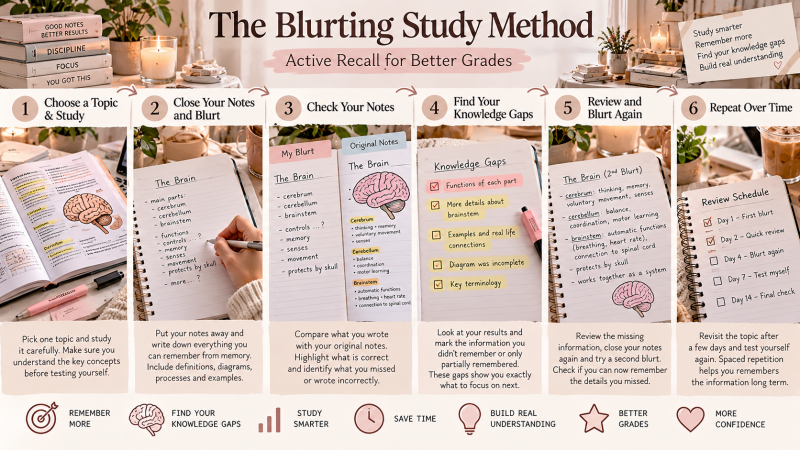
The Blurting Study Method is a simple study technique in which you learn a topic, put your study materials away and write down everything you can remember without checking your notes. You do not need to create beautiful notes or perfectly structured sentences. The purpose is to get the information out of your memory and onto the page so that you can see what you genuinely know.
Once you have finished, you compare your blurt with your original study material. Information that you remembered correctly shows you what is already becoming familiar, while missing or incorrect information reveals your knowledge gaps. Instead of treating those gaps as a failure, you use them as a personalized study guide because they tell you exactly what you should review next.
This changes the question from “How much have I studied?” to “What can I actually remember?” That small change can completely transform the way you approach a difficult subject.
Why Rereading Can Give You a False Sense of Confidence
One of the biggest study problems is confusing familiarity with knowledge. Imagine that you have read the same biology chapter three times. When you look at a definition, it feels obvious because you have seen it repeatedly. You might therefore assume that you know it, but if someone suddenly asks you to explain the concept without looking at the page, you may struggle.
This happens because rereading provides clues. The heading, diagrams, highlighted sentences and surrounding information are all helping you recognize the answer. An exam usually removes those clues and requires you to retrieve information from memory.
Blurting exposes this difference very quickly. When the book is closed and the blank page is in front of you, there is nowhere for your brain to hide. You either remember a piece of information, remember part of it, confuse it with something else or cannot retrieve it yet. That immediate feedback is what makes the exercise valuable.
The Connection Between Blurting and Active Recall
The popular name may be Blurting, but the important learning principle behind the technique is active recall, also commonly discussed as retrieval practice. Instead of repeatedly exposing yourself to information, you actively attempt to retrieve previously learned information from memory.
That distinction matters because Blurting itself should not be treated as a magical study hack. Its usefulness comes from what you are asking your brain to do. You are creating opportunities to retrieve information, check the accuracy of that retrieval and then strengthen the areas that remain difficult.
This also explains why simply copying your notes onto another page is not Blurting. If your textbook is open beside you and you can see the answers while writing, you are not genuinely testing recall. The challenge begins when the source material disappears.
How to Use the Blurting Method Step by Step
Start by choosing one clearly defined topic instead of attempting an entire subject at once. A topic such as “the stages of mitosis,” “causes of World War I” or “the structure of the heart” is much easier to test effectively than something enormous such as “biology” or “history.”
Study the selected topic carefully and make sure that you understand the basic concepts before testing yourself. Blurting is much more useful when you are trying to retrieve information that you have already encountered and understood. Once you have completed the initial learning phase, close your textbook, hide your notes and remove anything that could reveal the answers.
Take a blank sheet of paper and write the topic at the top. Now write everything you can remember. Include definitions, processes, formulas, dates, examples, connections and explanations that seem relevant. If drawing a diagram helps you explain the topic, draw it from memory. Continue until you feel that you have retrieved everything you currently can.
Only then should you reopen your notes and compare them with what you wrote. Mark information that was correct, identify anything important that was missing and correct information that was inaccurate. Pay particular attention to concepts that you thought you knew but could not explain clearly because those are often the most valuable discoveries in the exercise.
Your next study session should focus primarily on those gaps instead of starting the entire chapter again.
Turn Your Mistakes Into a Study Map
This is where Blurting becomes much more powerful than simply filling a page from memory. The first blurt is not the end of the process. It is a diagnostic tool that shows you where your study time has the greatest potential value.
Imagine that your topic contains ten important concepts. During your first attempt, you recall six confidently, partially remember two and completely miss two. It makes little sense to spend equal amounts of time reviewing all ten concepts again. Your results have already shown you where the weaknesses are.
Create three simple categories after checking your work: information you know confidently, information you partially know and information you cannot yet recall. Concentrate your next review on the second and third categories. This creates a more targeted study session and prevents you from repeatedly spending time on material that already feels secure. The goal is not to produce a perfect first page. The goal is to make your weaknesses visible while you still have time to fix them.
A Simple Blurting Example
Suppose you are studying the process of photosynthesis. You first learn the topic using your textbook, class notes or study materials. Afterward, you close everything and write “Photosynthesis” at the top of a blank page.
You might remember that plants use light energy, that chlorophyll is involved, that carbon dioxide and water are required and that glucose and oxygen are produced. You may also draw a chloroplast or attempt to write the chemical equation from memory. When you check your notes, you discover that you remembered the general process but forgot where specific reactions occur or confused part of the equation. Those missing details now become your priority.
After reviewing them, you close your materials again and attempt a second blurt. If you can now explain the details you previously missed, you have evidence that your review addressed a genuine weakness rather than simply making the page feel familiar again.
Use Questions to Make Blurting Even More Effective
A blank page can sometimes feel overwhelming, especially when you are learning a complex subject. If you cannot remember where to begin, use questions as retrieval prompts without writing the answers beside them.
For example, before studying a chapter, create questions such as “What are the main stages?”, “Why does this process happen?”, “What happens if this step fails?”, “How is concept A different from concept B?” and “Can I explain this in my own words?” When you begin your blurt, answer those questions entirely from memory.
This approach is particularly useful for subjects that require explanation rather than simple memorization. It forces you to organize information into meaningful relationships and makes it easier to identify whether you understand the topic or have only memorized isolated facts.
You can also transform headings from your textbook into questions. A heading called “Functions of the Nervous System” can become “What are the main functions of the nervous system and how do they work?” That simple change turns passive reading material into an active study prompt.
Combine Blurting With Spaced Repetition
One of the smartest ways to use Blurting is to avoid doing every recall attempt during a single study session. If you successfully remember something five minutes after reading it, that is useful, but it does not automatically mean that you will remember it next week.
Instead, revisit the topic after some time has passed. You might complete your first blurt after learning the material, return to the topic the next day and test yourself again several days later. The exact interval can vary depending on the subject, your exam date and how difficult the material is.
The important point is that each new attempt requires genuine retrieval. If a concept remains easy to recall over time, you may be able to review it less frequently. If you repeatedly forget something, it deserves more attention.
This creates a useful combination of retrieval practice and spaced review. Instead of repeatedly reading everything according to a fixed routine, you allow your performance to influence what you study next.
Try the 20 Minute Blurting Routine
You do not need an entire evening to use this method. A focused twenty minute session can be surprisingly productive when you already have some familiarity with the topic.
Spend approximately five minutes reviewing one clearly defined concept and making sure you understand it. Close your materials and spend around seven minutes writing everything you can remember. Use the next five minutes to compare your page with your source material and identify missing or incorrect information. Spend the final few minutes reviewing the most important gaps and deciding when you will test the topic again.
The exact number of minutes is less important than the structure. Every session should contain learning, retrieval, checking and correction. This prevents study time from becoming an endless cycle of reading and highlighting without ever discovering whether the information is actually available from memory.
Common Blurting Mistakes That Can Make the Method Less Useful
A common mistake is checking your notes too quickly. The uncomfortable moment when you cannot immediately remember an answer is part of the exercise. Give yourself time to search your memory before looking at the solution.
Another mistake is attempting topics that are far too large. Trying to blurt an entire semester of material onto one page can quickly become chaotic and discouraging. Smaller topics make it easier to identify precise weaknesses and track improvement.
You should also avoid turning Blurting into a handwriting or aesthetic notes project. Your page does not need perfect headings, matching highlighters or beautiful lettering. If creating an attractive page helps you enjoy studying, there is nothing wrong with that, but decoration should not replace retrieval.
Most importantly, do not stop after identifying a mistake. A highlighted gap tells you what went wrong, but correcting it once while looking at the answer does not prove that you can remember it. Review the missing information, remove the answer and test yourself again.
Blurting Is Not Ideal for Every Learning Task
Blurting can be especially useful when you need to remember concepts, processes, terminology, relationships, definitions and structured information, but no single study technique is perfect for every subject.
If you are learning mathematics, physics or accounting, for example, retrieving formulas can be useful, but you still need to solve actual problems. If you are learning a language, recalling vocabulary can help, but you also need listening, speaking, reading and writing practice. If you are preparing for an essay based exam, remembering facts is only one part of the task because you also need to practice organizing arguments and writing under exam conditions.
Think of Blurting as one tool inside a larger study system. Use it when retrieval is important and combine it with the type of practice that your actual assessment requires.
How to Know When You Really Know a Topic
A filled page is not necessarily proof that you have mastered something. A better test is whether you can retrieve the important information accurately after time has passed and explain it without relying heavily on prompts.
Try explaining the topic as if you were teaching someone who has never studied it before. Can you define the important terms, describe how the pieces connect and answer basic questions about why the process works? Can you still do this tomorrow without rereading everything first?
If the answer is yes, the information is becoming much more accessible. If you repeatedly get stuck at the same point, that is useful information too because you have identified exactly where further study is required. This creates a much healthier way to measure progress. Instead of counting pages read or hours spent at your desk, you begin measuring what you can understand, retrieve and apply.
Create Your Own Blurting Study System
The real value of this method appears when it becomes part of a repeatable routine rather than something you try once before an exam. Keep a record of the topics you test, the gaps you discover and how confident you feel after each attempt.
You can use a simple confidence scale from one to five. A score of one might mean that you could barely recall the topic, while five means that you can explain it confidently without assistance. Topics with lower scores can return to your study schedule sooner, while stronger topics can be checked again later.
Over time, your study plan becomes increasingly personalized. Instead of asking yourself what you should study tonight, you already have evidence showing which topics need attention. That is one of the biggest advantages of active study methods. They do not only help you practice remembering information. They also give you feedback about your own learning.
Free Blurting Study Sheet
If you want to try this method without having to create your own system from scratch, I created a free Blurting Study Sheet that you can use during your next study session.
The sheet guides you through the process from choosing your topic and completing your first blurt to checking your notes, identifying missing information, correcting your knowledge gaps and testing yourself again. You can also use it to track your confidence and decide which topics need another review.
You can find the Free Blurting Study Sheet in the Dayna Ashfort Studio Free Printable Library and use it for school, college, university or exam preparation.
Final Thoughts
The Blurting Study Method is valuable because it changes the purpose of a study session. Instead of trying to make information look familiar, you are testing whether you can actually retrieve and explain it. Every forgotten definition, incomplete explanation and incorrect detail becomes useful feedback that can guide your next study session.
You do not need to abandon your planner, flashcards, study notes or favorite study routine. Simply add moments where the notes disappear and your memory has to do the work. Study the topic, close the material, retrieve what you know, check the gaps, correct them and return to the topic later.
Once you start studying this way, a blank page stops being intimidating. It becomes a map showing you exactly what you know, what you are still learning and what you should study next.
See you in the next edition. ♡
Dayna Ashfort Studio
Create beautifully. Study smarter. Work with intention.
Kommentar hinzufügen
Kommentare