


Studying for an exam can feel productive when you are rereading notes, highlighting pages and reviewing the same material again and again, but recognizing information is not the same as being able to recall it when you need it. The Blurting Method turns revision into an active process by asking you to close your notes, write down everything you remember and then identify exactly what is missing. In this guide, you’ll learn how to use blurting as a practical exam revision routine, how to combine it with active recall and repetition, and how to focus your study time on the topics that actually need more attention.
How to Use the Blurting Method for Exam Revision: A Step-by-Step Study Routine
Preparing for an exam often creates a strange problem. You can spend hours studying, recognize almost everything in your notes and still struggle to explain the material without looking at the page. This happens because reading information repeatedly can create familiarity without creating strong recall. During an exam, however, your notes are no longer in front of you. Your brain has to retrieve the information independently, which is exactly the skill the Blurting Method helps you practice.
The Blurting Method turns revision from passive reviewing into active testing. Instead of asking yourself whether something looks familiar, you ask a much more useful question: what can I actually remember without help? You study a manageable topic, remove the material from view and write everything you can recall. You then compare what you remembered with the original material, identify the gaps and revise those areas before testing yourself again. The result is a study routine that constantly shows you what you know, what you almost know and what still needs attention.
Why the Blurting Method Works So Well for Exam Revision
One of the biggest difficulties during exam preparation is deciding where to spend your limited study time. When you repeatedly read an entire chapter, strong and weak areas receive almost the same amount of attention. You might spend twenty minutes reviewing information you already understand while overlooking a small but important concept that you cannot actually recall.
Blurting changes this because every session produces evidence. A nearly complete page tells you that the topic is becoming secure, while missing definitions, confused steps or incorrect explanations immediately reveal where additional revision is needed. Instead of studying everything equally, you can gradually concentrate your effort on the areas where your memory is weakest.
This is also why blurting works naturally with active recall. You are not simply exposing yourself to information again. You are attempting to retrieve it before checking the answer. That retrieval attempt is important because it transforms studying into practice for the situation you will eventually face during an exam.
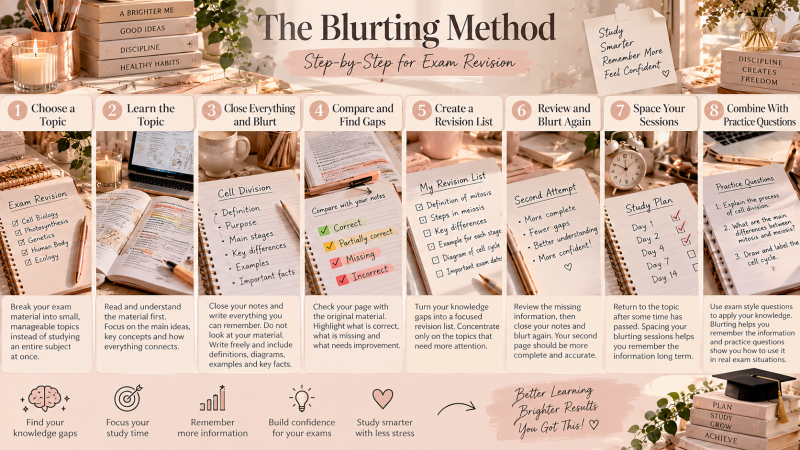
Step 1: Break Your Exam Material Into Small Topics
The quality of a blurting session begins before you write anything. Trying to blurt an entire subject at once usually creates an overwhelming page and makes it difficult to understand what your mistakes actually mean. Divide your exam material into smaller topics that can be tested individually.
For example, instead of writing “Biology” at the top of your page, choose something more specific such as cell division, photosynthesis, genetics or the cardiovascular system. A history student might separate one chapter into causes, key events, important people, dates and consequences. A business student could divide a topic into definitions, theories, formulas, processes and examples.
The goal is to create study units small enough that you can clearly judge your knowledge. This makes your revision measurable and prevents the common feeling that you have studied for hours without knowing whether you have actually made progress.
Step 2: Learn the Topic Before You Test Yourself
Blurting is most effective when it is used to retrieve information rather than replace the initial learning process. If a topic is completely new, first spend time understanding it. Read your notes, textbook or learning material carefully and focus on the structure of the topic rather than trying to memorize every sentence.
Ask yourself what the main idea is, which concepts belong together, what causes what, which steps must happen in a particular order and which details are likely to matter in an exam. When you understand how the information connects, you give your memory a framework instead of a collection of isolated facts.
Once you can explain the basic idea to yourself, close the material. This is where the real test begins.
Step 3: Close Everything and Start Blurting
Take a blank sheet of paper and write the topic at the top. Without checking your notes, write everything you can remember about it. Include definitions, formulas, examples, processes, dates, keywords, diagrams or explanations depending on the subject you are studying.
Do not worry about making the page beautiful. This is not note taking and it is not supposed to become another polished summary. The purpose of the page is to expose your current memory as accurately as possible.
When you become stuck, resist the urge to immediately look at your notes. Give yourself time to search your memory. Think about where the information appeared on the page, what concept came before it, what example your teacher used or how it connects to something else you remember. Even when the answer does not appear immediately, the attempt itself makes the exercise more meaningful than simply reading the answer again.
Step 4: Compare Your Blurt With the Original Material
Once you have written everything you can remember, open your notes and compare them carefully with your page. This is where blurting becomes much more powerful than a simple memory exercise. Look for information that is completely missing, information you remembered only partially and information you remembered incorrectly. You can mark these gaps directly on your blurting sheet using a different color or create a short correction section underneath your original attempt.
Pay particular attention to incorrect information. Forgetting something tells you that a memory needs strengthening, but confidently remembering something incorrectly can be even more important because you need to correct the association before repeating it. At this stage, your mistakes become useful information. They are no longer proof that a study session went badly. They are instructions telling you exactly what to study next.
Step 5: Turn Your Knowledge Gaps Into a Revision List
After comparing your page with your notes, do not immediately reread the entire topic. Use the gaps you discovered to create a focused revision list. If you remembered nine out of ten concepts correctly, there is little reason to spend the next thirty minutes reviewing all ten equally. Focus on the missing concept. If you understand a process but repeatedly forget two steps in the middle, concentrate on those steps. If you remember a definition but cannot provide an example, practice applying the concept instead of memorizing the definition again.
This is one of the most valuable changes blurting can bring to your study routine because revision becomes increasingly personalized. Your study plan is no longer based only on chapters or pages. It begins to reflect the actual condition of your knowledge.
Step 6: Correct the Gaps Before Blurting Again
Spend a short period actively reviewing the areas you missed. Try to understand why you forgot them rather than simply reading them several times. You might turn a complicated process into a simple sequence, connect a difficult definition to an example, draw a diagram, explain a concept aloud or create a question that forces you to retrieve the missing information. The goal is to make the weak information easier to understand and easier to retrieve.
Then close your notes again and repeat the blurt. Ideally, use a fresh page so you are retrieving the information rather than remembering where you wrote it during the previous attempt. The second page should become more complete, but perfection is not necessary. What matters is whether your gaps are becoming smaller.
Step 7: Space Your Blurting Sessions Instead of Repeating Them Continuously
It can be tempting to repeat the same blurting exercise several times in one sitting until the page is perfect. This may feel satisfying, but immediate repetition can make information temporarily easy to retrieve because you have just seen it. A more revealing test happens after some time has passed. Return to the topic later and try again without reviewing it first. Depending on your exam schedule, this could mean revisiting the material the following day and then again several days later.
If you can still reproduce the important information after a delay, you have much stronger evidence that the knowledge is becoming accessible. If large sections disappear again, that topic should return to your revision schedule. This creates a simple cycle of learning, retrieving, checking, correcting, waiting and retrieving again.
How to Build a Blurting Study Routine Before an Exam
You do not need to use blurting for every minute of your revision. A better approach is to make it one part of a broader exam routine.
At the beginning of a study session, choose one or two specific topics rather than opening an entire subject. Review the first topic until you understand it, complete a blurt and check your gaps. Spend the next part of the session correcting those weaknesses before moving to practice questions or another form of active revision.
At the end of the session, record the topic and how confident you felt. You might classify it as strong, developing or needs review. The labels themselves are less important than having a system that tells you what should appear in your next study session. Over time, your revision schedule starts changing automatically. Strong topics appear less frequently while difficult topics receive more attention. Instead of wondering what to study every evening, your previous sessions help make that decision for you.
Use Blurting Differently for Different Subjects
Blurting does not have to look identical for every subject. The method becomes more useful when you adapt it to the type of knowledge your exam requires.
For subjects with many definitions and concepts, you can write keywords and explain each one from memory. For science subjects, you can recreate diagrams, processes and cause and effect relationships. For history, you might reconstruct timelines, events and consequences. For languages, you can retrieve vocabulary, grammar rules and example sentences. For mathematics, blurting can help with formulas, rules and problem solving steps, although actual practice problems should remain an important part of revision. The key principle remains the same. Your page should require you to produce information without seeing the answer first.
Do Not Turn Blurting Into Another Note Taking Project
One of the easiest mistakes is spending too much time making blurting pages aesthetically perfect. Color coding can help you identify corrections, but the page does not need perfect handwriting, decorative headings or an elaborate layout. If creating the sheet takes longer than retrieving the information, the method has started serving the page rather than your learning.
A messy page that accurately reveals five knowledge gaps can be far more valuable than a beautiful page copied almost entirely from your textbook. Blurting is a diagnostic tool first. Its job is to show you the truth about what your brain can retrieve.
What to Do When Your Mind Goes Completely Blank
A blank page can feel discouraging, particularly when you thought you knew the topic well. However, this is one of the most useful moments in the entire method because it reveals the difference between recognition and independent recall. If very little comes to mind, do not conclude that you are bad at studying. Instead, make the topic smaller. Review one section, close the material and test yourself on that section alone. Once you can retrieve it reliably, add another piece.
You can also use prompts at first. Write a few questions or headings on the page before closing your notes and then answer them from memory. As your knowledge improves, remove the prompts and attempt a completely blank page. The objective is not to prove how much you already know. It is to create a system that gradually makes more information retrievable.
Combine Blurting With Exam Questions
Blurting can tell you whether you remember information, but many exams require more than recall. You may need to analyze, calculate, compare, evaluate or apply what you know to an unfamiliar situation. For that reason, one of the strongest ways to use blurting is to combine it with practice questions. First use blurting to identify and strengthen your knowledge. Then use exam style questions to practice applying that knowledge under conditions closer to the real assessment.
If you remember a concept during blurting but cannot use it correctly in a question, you have discovered a different kind of gap. Your factual knowledge may be strong while your application still needs practice. This distinction can save enormous amounts of study time because it tells you whether your problem is remembering the material or knowing what to do with it.
Create a Simple Blurting Progress System
As your exam approaches, keep a basic record of your blurting sessions. Write down the topic, the date, the areas you missed and when you plan to test the topic again.
You do not need a complicated productivity system. A simple tracker can show you patterns that are difficult to notice from individual study sessions. You may discover that certain topics disappear from memory quickly, while others remain strong after several days. You may also notice that one subject requires more frequent retrieval practice than another. This turns revision into a feedback loop. Every study session produces information that improves the next one.
Stop Measuring Study Success by Hours Alone
One of the most important lessons the Blurting Method can teach you has very little to do with the page itself. It changes how you define a productive study session.
Three hours at a desk does not automatically mean three hours of effective learning. A shorter session in which you retrieve information, discover your weaknesses, correct them and successfully test yourself again may tell you far more about your exam readiness. Instead of finishing the day by asking how long you studied, ask what you can now explain without your notes, which gaps you discovered and what needs to happen next.
That shift can make studying feel much less chaotic because progress becomes something you can see.
Your Blurting Method Exam Revision Routine
A practical blurting routine does not need to be complicated. Start with one manageable topic, understand the material, close your notes and write everything you remember. Compare your page with the original information, highlight the gaps and correct only what needs attention. Return to the topic after some time has passed, retrieve it again and combine your knowledge with exam style questions.
As your exam gets closer, your pages should gradually reveal fewer gaps and your attention should move toward the areas that still cause difficulty. Instead of repeatedly starting from the beginning of your notes, you are continuously narrowing your revision toward what matters most.
That is where the Blurting Method becomes more than another study trend. It gives you a way to turn uncertainty into information, mistakes into a revision plan and an overwhelming amount of exam material into a series of manageable decisions. You do not need to know everything perfectly today. You need a reliable way to discover what you know, identify what you do not know yet and decide exactly what to study next.
When your revision begins answering those questions for you, studying stops feeling like endless repetition and starts becoming a process with direction.
Ready to Make Studying Feel a Little Easier?
Effective studying does not have to mean longer hours, more complicated routines or another notebook full of information you never look at again. The right tools can help you organize what you need to learn, see your progress more clearly and turn overwhelming study sessions into manageable steps.
If you want a little extra support, explore the Dayna Ashfort Studio Free Printable Library for free study sheets, planners, trackers and practical printables designed to help you study with more structure and less stress. If you are ready to build a complete study system, visit the Dayna Ashfort Studio Shop for printable bundles and planning tools created to bring everything together in one place.
Start with what you need today, build your routine one step at a time, and make studying work for you. ♡
See you in the next edition. ♡
Dayna Ashfort Studio
Create beautifully. Study smarter. Work with intention.
Kommentar hinzufügen
Kommentare