


Starting a small business can feel exciting until you realize how many decisions suddenly need to be made. What should you do first? Do you need a business plan? How much money should you prepare? When should you build your website, start marketing or officially launch? The good news is that starting a business becomes much easier when you stop trying to do everything at once and follow the right order instead. This guide walks you through the essential steps of starting a small business in 2027, from shaping your idea and understanding your customer to organizing your finances, creating your brand and preparing for launch. Whether you are building an online business, creative business or small service-based brand, you can use this as your roadmap from idea to launch.
Step 1: Start With a Problem, Not a Perfect Business Idea
One of the biggest misconceptions about starting a business is that you need a completely original idea before you can begin. In reality, many successful small businesses are not built around something the world has never seen before. They are built around solving an existing problem in a clearer, easier, faster or more enjoyable way.
Instead of asking yourself what kind of business you should start, begin by asking what problem you could help someone solve. Think about the questions people repeatedly ask, the tasks they find frustrating, the things they spend too much time doing or the results they want but struggle to achieve on their own.
A useful business idea sits at the intersection of a real problem, a specific person and a solution you are capable of providing. A parent who constantly struggles to organize family finances may need a simple budgeting system. A student who feels overwhelmed before exams may need better study tools. A local business that rarely posts online may need someone to manage its social media. A busy professional may happily pay for a service that saves several hours every week.
You do not need to know every detail of your future business yet. At this stage, you simply need to be able to complete one sentence clearly: My business helps this type of person solve this specific problem by providing this solution. That sentence gives you something much more valuable than a beautiful logo. It gives your business a reason to exist.
Step 2: Define Exactly Who You Want to Help
Trying to sell to everyone often makes a new business harder to understand. When your audience is too broad, your website becomes vague, your marketing becomes generic and potential customers struggle to recognize whether your offer was actually created for them.
Imagine two businesses offering productivity planners. One says that its planner is designed for anyone who wants to become more productive. The other creates a planner specifically for overwhelmed college students who constantly forget assignments, procrastinate before exams and need a simple weekly study system.
The second business immediately has clearer product ideas, clearer marketing messages and clearer search terms because it understands the person behind the purchase. Create a simple picture of your ideal customer by thinking beyond age and location. Ask what they are trying to accomplish, what repeatedly frustrates them, what they have already tried, what prevents them from succeeding and what would make their life noticeably easier. The better you understand the situation your customer is experiencing before discovering your business, the easier it becomes to create something they actually want.
Step 3: Validate the Idea Before You Spend Months Building It
Excitement can make new entrepreneurs want to build everything immediately. They create a website, order packaging, design dozens of products and spend money on branding before knowing whether customers are actually interested. There is a safer approach.
Look for evidence of demand before investing heavily in the idea. Search Google and Pinterest for the problem you want to solve. Explore marketplaces related to your industry. Read customer reviews of competing products and pay particular attention to complaints because complaints often reveal opportunities. Look at questions people repeatedly ask in communities, search results and comment sections.
You are not looking for proof that nobody has ever created your idea before. Competition can actually be useful because it demonstrates that people already spend money in the category. What you need to discover is whether there is demand and whether you can create a meaningful reason for someone to choose your solution.
You can also test your idea with a small version of your offer. A digital product business might launch one useful template instead of creating fifty products. A service business might work with its first few clients before building complicated packages. A handmade business might release a small collection before investing in large amounts of inventory. Your first version does not need to prove that you have built the perfect company. It needs to teach you what customers actually want.
Step 4: Create a Simple Business Model
A business becomes much less intimidating when you understand how money is supposed to move through it. Your business model does not need to be complicated. You need to know what you sell, who buys it, approximately what it costs you to provide it, how much you charge and how customers discover it.
For example, someone building a digital product business might sell printable planners through an online store. Their customers could discover those products through Google, Pinterest or social media. Because digital products can be delivered automatically, the cost of fulfilling an additional order may be relatively low, although the business will still have expenses such as software, payment processing, advertising and website fees.
A service provider will have a different model because time is part of the cost. If you charge $200 for something that requires twenty hours of work, your revenue may look attractive while the actual business model is unsustainable.
This is why revenue alone never tells the entire story. You need to understand what remains after the costs required to generate that revenue. Before moving forward, write down your main offer, expected price, estimated cost per sale, expected monthly expenses and the number of customers you would need to reach your first meaningful revenue goal. Suddenly, an abstract dream starts becoming something you can calculate.
Step 5: Research the Market Without Becoming Obsessed With Competitors
Market research is not about copying businesses that already exist. It is about understanding the environment you are entering. Study several businesses serving a similar customer and look at what they sell, how they position their offers, which problems they emphasize, what customers praise and what customers wish were better. Then step away from those businesses and think about what you want your own customer experience to feel like.
Perhaps competitors provide excellent products but confusing instructions. Maybe they focus on advanced users while beginners feel ignored. Perhaps their products are functional but visually uninspiring. Maybe their customer service is slow or their offer requires too many complicated steps.
Those gaps can become part of your positioning. You do not have to be cheaper than everyone else, and you do not have to invent an entirely new market. You need a clear reason why your particular customer might prefer your particular solution.
Step 6: Build Your Brand Around a Feeling and a Promise
Branding is much bigger than choosing colors and fonts. Your brand is the expectation people develop when they encounter your business. Ask yourself what you want customers to feel when they visit your website or use your product. Perhaps you want them to feel organized, calm and capable. Maybe you want them to feel ambitious and energized. Perhaps your business should feel luxurious, playful, practical or reassuring.
Then connect that feeling to a promise. A strong brand communicates what kind of transformation customers can expect. Someone should be able to visit your website for the first time and quickly understand who you help, what you offer and why it matters.
Visual branding should support that message rather than replace it. A beautiful website cannot rescue an unclear offer, but a clear offer presented through thoughtful branding can become remarkably memorable. You do not need a perfect brand identity before your first sale. Start with a consistent visual direction, a recognizable business name and a clear message. Your brand can become more sophisticated as the business grows.
Step 7: Understand Your Numbers Before Money Starts Moving
Finances are one of the areas new business owners often postpone because they feel complicated, but creating a simple financial system at the beginning is much easier than trying to reconstruct months of transactions later.
Start by listing your expected startup costs and recurring business expenses. Depending on your business, this might include registration costs, equipment, inventory, software subscriptions, website hosting, professional services, payment processing fees, marketing and taxes. Then determine what a sale is actually worth to your business. If a customer pays $50 but fulfilling the order costs $20 and payment fees consume another amount, your profit is not $50.
Create a habit of recording business income and expenses from the beginning and keep business transactions as separate from personal spending as your local banking and legal circumstances allow. You should always be able to answer three basic questions: how much money entered the business, how much money left the business and what remained.
Taxes, registration requirements, licenses and business structures vary significantly between countries and locations, so these are areas where local official guidance or a qualified professional matters. A general online checklist can help you prepare, but it cannot replace the rules that apply where your business is actually established.
Understanding your finances should not make entrepreneurship feel frightening. It should do the opposite. Numbers replace uncertainty with information.
Step 8: Create the Smallest Version of Your Offer That Delivers a Real Result
Your first product or service does not need to demonstrate everything you are capable of creating. It needs to solve one problem well. This concept can save new business owners months of unnecessary work. Instead of launching an enormous product collection, choose one problem and build one useful solution around it. Instead of offering ten different services, start with one package you can explain clearly.
Ask yourself what the customer is struggling with before purchasing and what should be easier after using your product or service. That difference is the value you are selling. If someone purchases a study planner, they are not really buying pages. They are buying a system that helps them feel more prepared. If someone hires a virtual assistant, they are not simply buying hours. They are buying back time. If someone purchases a meal planning template, they are buying relief from repeatedly wondering what to cook.
When you understand the transformation, writing product descriptions and marketing content becomes dramatically easier because you stop describing features and start communicating outcomes.
Step 9: Set Up a Simple Online Home for Your Business
You do not need to be everywhere online when your business launches. You need one reliable place where someone can understand your business and take the next step. For many small businesses, this will be a website or online shop. Keep the first version simple. Explain what you offer, who it is for, what problem it solves and what the visitor should do next. Depending on the business, that next action could be purchasing a product, booking a service, requesting a quote, joining an email list or contacting you.
Make important information easy to find. Customers should not have to search through several pages to understand pricing, delivery, policies or how to purchase. Your website should function as the home of your business rather than merely a digital brochure. Over time, helpful articles, search optimized pages, free resources and product pages can create multiple paths through which people discover you.
That is when a website starts becoming an asset rather than simply another business expense.
Step 10: Choose Marketing Channels Based on How Customers Search
One of the easiest ways to exhaust yourself is trying to use every marketing platform at once. Instead, think about customer behavior. If people actively search for solutions related to your business, search driven platforms can be especially valuable. Google can connect useful articles and product pages with people searching for specific answers, while Pinterest can help visual, educational and inspirational content continue circulating beyond the day it was published.
Other businesses may benefit more from short form social content, local search, professional networking, marketplaces, email marketing or direct outreach. Choose one or two primary acquisition channels and learn how they work before expanding.
More platforms do not automatically create more customers. A small number of connected channels can be much more powerful when they lead people toward the same destination. For example, a useful Pinterest post can lead someone to an educational blog article. That article can offer a free resource. The resource can introduce a relevant paid product. The customer can then join an email list and return later for another solution. That is no longer a collection of random
Step 11: Create a Launch Plan That Does Not Depend on Going Viral
Your business launch does not need thousands of followers, a huge advertising budget or a viral video. A strong launch is simply the moment when your business becomes ready to serve real customers.
Before launching, test your website, checkout process, contact forms and product delivery. Read your pages from the perspective of someone who has never heard of your business. Make sure pricing and instructions are clear and verify that customers know what happens after they purchase.
Then start talking about the problem your business solves rather than repeatedly announcing that your business exists. Create useful content around the questions your customers already have. Show how your product works. Explain common mistakes. Demonstrate the result. Share helpful information that allows someone to benefit from encountering your brand even before they buy anything. This builds trust much more effectively than repeatedly telling strangers to purchase.
Step 12: Build Systems Before You Become Busy
A business often feels manageable when there are only a few customers. The problems appear when orders, messages, content, invoices and administrative tasks begin arriving at the same time. Simple systems protect you from that chaos.
Create a place for important business documents. Decide how you will record expenses. Create reusable templates for frequent emails. Keep a content calendar if marketing requires regular publishing. Document the steps involved in delivering your product or service. You do not need sophisticated software for every process. A spreadsheet, calendar, folder structure or checklist may be enough.
The goal is to stop requiring your brain to remember every detail. Every process you organize today creates additional capacity for the business you want to have tomorrow.
Step 13: Set a 90 Day Goal Instead of Trying to Build the Entire Future
A new business can feel overwhelming because your mind immediately jumps several years ahead. You start thinking about thousands of customers, employees, taxes, advertising campaigns, complicated technology and problems that do not exist yet.
Bring the timeline back to the next ninety days. Choose one meaningful business goal and identify the actions that could realistically move you toward it. Your first goal might be launching your website, finding your first five customers, making your first ten sales, publishing ten useful articles or validating your first product.
Then translate that goal into monthly priorities and weekly actions. This changes the emotional experience of entrepreneurship because you are no longer trying to build an entire company today. You are simply completing the next useful step. Progress becomes visible, and visible progress builds confidence.
Step 14: Treat Your First Customers as Research
Your earliest customers can teach you things no business plan can predict. Pay attention to what they ask before purchasing, what makes them hesitate, which product they choose, how they describe their problem and what they say after using your solution.
If several people ask the same question, your website may need clearer information. If customers repeatedly request the same additional feature, you may have discovered your next product. If one article consistently attracts visitors, you may have found a topic worth expanding. If people click a product but rarely purchase it, the problem may be the offer, price, presentation or purchase experience.
Do not interpret every disappointing result as failure. Treat it as information. A business is not something you design perfectly in private and reveal to the world when it is finished. It becomes stronger through interaction with real customers.
Step 15: Review Your Business Every Month
Once your business is running, create a simple monthly business reset. Review your revenue, expenses, sales, website traffic, customer questions, marketing performance and progress toward your current goal. Identify what worked particularly well and what consumed time without producing meaningful results.
Then decide what you will continue, improve, test or stop during the next month. This habit prevents you from building your business entirely from emotion. A slow day does not mean the business is failing, just as one successful post does not mean you have discovered a permanent strategy. Patterns become visible when you look at data over time. Your monthly review is where activity becomes strategy.
Your First Business Does Not Need to Start Big
Perhaps the most important thing to understand about starting a small business in 2027 is that you do not need to have the entire journey figured out before you begin. You do not need fifty products. You do not need thousands of followers. You do not need an expensive website, a perfect logo or a complicated business plan covering the next five years.
You need a real problem, a useful solution, a way for the right people to discover it and enough patience to learn from what happens next. Start with one customer. One product. One service. One useful piece of content. One week of consistent work. Then use what you learn to decide what comes next.
The businesses that look polished today also had a beginning. There was a first website, a first product, a first customer and a first month when the numbers were small. Growth happens because those small beginnings are allowed to become something larger. You are not required to feel completely confident before starting. Confidence often arrives after you take action and discover that the things that once seemed intimidating can actually be learned. Your first step does not have to be impressive. It simply has to move you forward.
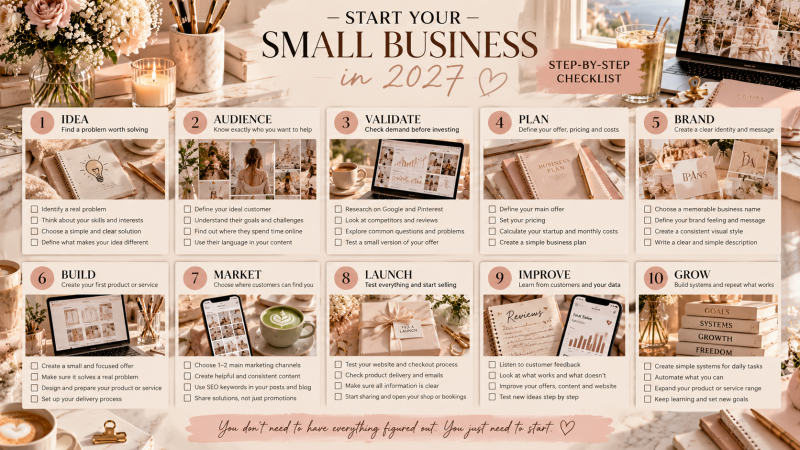
Your Small Business 2027 Checklist
Before you launch, make sure you can clearly describe the problem your business solves and the customer you want to serve. Validate that people are actively looking for solutions in your market, define your first offer and understand how it will generate revenue. Research your competitors without copying them, create a clear brand direction and calculate your startup and recurring costs.
Once the foundation is clear, build the smallest useful version of your product or service, create a simple online home for your business and choose one or two marketing channels where your customers already search for information. Test the complete customer journey before launching, organize your essential business systems and give yourself one measurable ninety day goal.
After launch, continue listening to customers, reviewing your numbers and improving what already works before constantly adding something new. You do not have to build everything at once. You only need to build the next piece well. And that is how a business begins.
See you in the next edition. ♡
Dayna Ashfort Studio
Create beautifully. Study smarter. Work with intention.
Kommentar hinzufügen
Kommentare