


You know exactly what you need to do, but somehow you still cannot start. The task may even be simple, yet your brain feels stuck between thinking about it and actually doing it. This experience is often described as ADHD task paralysis, and it can turn studying, cleaning, working or everyday responsibilities into something that feels much bigger than it really is. The goal is not to force yourself to become more productive overnight. Instead, a few ADHD-friendly strategies can help reduce the pressure, make tasks feel smaller and give your brain an easier place to begin. In this guide, you’ll learn nine practical ways to move from feeling stuck to taking that first manageable step.
ADHD Task Paralysis: 9 Ways to Start Tasks When You Feel Completely Stuck
There is a frustrating kind of stuck that has nothing to do with not caring about what needs to be done. You can see the laundry waiting, the assignment sitting on your desk, the email that needs an answer or the project you genuinely want to work on, and still find yourself unable to begin. You may think about the task repeatedly, tell yourself that you will start in five minutes and become increasingly stressed as more time passes, yet somehow the distance between knowing and doing continues to feel enormous.
For people with ADHD, this experience is often described as task paralysis. It can be especially confusing because from the outside the solution appears obvious. Just start. Inside the moment, however, starting may be exactly the part that feels impossible. Understanding what is happening can completely change the way you approach these situations because instead of trying to create more pressure, you can begin removing the barriers that are making the first step so difficult.
Why ADHD Task Paralysis Can Make Simple Tasks Feel So Difficult
A task does not have to be objectively difficult to feel overwhelming. Sometimes the problem is that there are too many possible starting points, too many decisions involved or no clear first action. A task such as cleaning the bedroom may secretly contain twenty smaller tasks. You need to pick up clothes, decide what needs washing, clear the desk, put objects away, empty the bin, change the bedding and work out where everything belongs. Your brain is therefore not responding to one task called “clean the bedroom.” It may be trying to process an entire collection of decisions at once.
The same thing can happen with studying. “Study for the exam” sounds like one instruction, but it does not tell you what to open, what topic to start with, how long to study, what method to use or when you will know that you have done enough. When the starting point is unclear, it becomes easy to remain in the planning stage while feeling as though you should already be working. This is why an effective ADHD-friendly approach is often not about increasing motivation. It is about reducing friction between you and the first action.
1. Stop Asking Yourself to Finish and Ask Yourself to Begin
One of the most useful changes you can make is separating starting from finishing. When your brain hears that you need to write an essay, clean the kitchen or complete a presentation, it may immediately imagine the entire amount of effort ahead. The task becomes mentally expensive before you have even touched it. Instead, decide what beginning looks like.
If you need to study, beginning might mean opening your notes to the correct chapter and writing down the first topic. If you need to clean, beginning might mean putting five objects back where they belong. If you need to write, beginning might simply mean opening the document and typing a rough heading.
This may seem almost too small to matter, but that is exactly the point. The first action should not impress you. It should be easy enough that your brain has very little reason to negotiate with it. Once movement exists, continuing often requires less effort than creating that movement in the first place.
2. Find the Hidden Problem Inside the Task
When you keep avoiding the same task, try replacing the question “Why am I not doing this?” with “What part of this task is making it difficult to start?”
The answers can be surprisingly specific. Perhaps you do not know what the first step is. Maybe the task feels boring, you are afraid of doing it badly or you think it will take much longer than you can handle. You might be tired, overstimulated or distracted. Sometimes you are not avoiding the actual task at all. You are avoiding a decision hidden inside it.
Imagine that you have been postponing an important email. The problem may not be writing the email. The real problem might be that you do not know how to word one uncomfortable paragraph. Once you identify that specific obstacle, the enormous task suddenly becomes a much smaller problem that can actually be solved. Learning to locate the friction is one of the most useful productivity skills you can develop because it turns vague overwhelm into something concrete.
3. Make the First Step Almost Ridiculously Small
Traditional to do lists often describe outcomes rather than actions. “Finish presentation,” “study biology” and “organize office” tell you where you eventually want to arrive, but they do not necessarily tell your brain what to do right now. Try shrinking the task until the first action becomes obvious.
Instead of “study biology,” your first action could be “open chapter six and read the first heading.” Instead of “organize my finances,” it could be “open my bank statement.” Instead of “work out,” it could be “put on my workout clothes.” There is no prize for making the first step difficult. Your objective is to create momentum.
This technique becomes even more powerful when you prepare the first step in advance. Leaving the textbook open on your desk, placing your notebook beside your laptop or writing tomorrow’s first work task before finishing for the day removes decisions from the moment when you are most likely to become stuck.
4. Use a Five Minute Start Instead of Waiting for Motivation
Waiting until you feel ready can quietly consume an entire day. A better approach is to make a temporary agreement with yourself that you only need to work for five minutes. Set a timer and begin the smallest version of the task. During those five minutes, you are not trying to complete everything. You are simply giving yourself enough time to cross the starting line.
When the timer ends, you can decide whether to continue. This distinction matters because a five minute commitment feels very different from an undefined amount of work. An open ended task can feel threatening when you are already overwhelmed, while a short period has a visible ending.
You may sometimes stop after five minutes, and that does not make the strategy unsuccessful. Five minutes of progress is still progress, and repeatedly practicing the act of starting can help make future starts feel less intimidating.
5. Get Everything Out of Your Head Before You Organize It
When your mind is holding twelve unfinished thoughts at once, deciding what to do first becomes much harder. This is where a simple brain dump can be incredibly useful. Write down everything competing for your attention without trying to organize it immediately. Include the important tasks, tiny reminders, things you are worried about forgetting, messages you need to send and random thoughts that keep returning.
Only after everything is visible should you begin sorting. You might discover that twenty thoughts actually represent six tasks. You might notice that three things can wait until next week. You may find one task that takes two minutes and another that needs to be broken into several stages.
The purpose of a brain dump is not to create the perfect productivity system. It is to stop your working memory from functioning like a crowded waiting room. Your planner can hold information so your brain does not have to hold all of it at the same time.
6. Create a Distraction Parking Lot
Trying to concentrate does not necessarily stop new thoughts from appearing. You may suddenly remember that you need toothpaste, wonder whether you replied to a message, think of something you want to search online or remember another task that feels strangely urgent.
If you act on every thought, your original task disappears. If you try desperately not to forget the thought, part of your attention remains attached to it. A distraction parking lot gives those thoughts somewhere to go. Keep a small section of paper beside you and write down anything unrelated that appears while you are working. You are not ignoring the thought and you are not acting on it immediately. You are storing it somewhere reliable so you can return to it later.
At the end of your work or study session, review the list. Some items will need action, while others may no longer feel important at all. This tiny system can make focus feel much less restrictive because you are not asking your brain to stop generating thoughts. You are simply giving those thoughts a place that is not the middle of your current task.
7. Borrow Momentum With Body Doubling
Sometimes working beside another person can make it easier to stay connected to a task. This is commonly called body doubling, and it does not require the other person to help you complete the work. You might study beside a friend, work quietly while someone else works on their laptop or join a virtual focus session. The important part is the sense that you are no longer trying to create structure entirely by yourself.
You can make this more effective by stating your goal before you begin. Instead of saying that you are going to “get some work done,” decide that you are going to complete the introduction, review twenty flashcards or organize one folder. A defined goal gives the session an endpoint and makes progress easier to recognize.
Body doubling will not work for everyone or every situation, but if you repeatedly notice that you function better when someone else is quietly working nearby, it can be useful to build that environment intentionally rather than waiting for it to happen.
8. Make Time Visible
Time can feel abstract, especially when a task has no obvious beginning or ending. You may assume something will take hours and avoid it, only to discover later that it required fifteen minutes. At other times, you may expect a task to take twenty minutes and suddenly realize that two hours have passed.
Instead of relying entirely on your internal sense of time, create visible boundaries. Use a timer, a clock within sight or a clearly defined work block. Before beginning, estimate how long you think the task will take. Afterward, write down how long it actually took.
This simple practice can gradually give you more realistic information about your own routines. You may discover that emptying your inbox is not the enormous project you imagined, while preparing a presentation consistently requires more time than you expect. The goal is not to schedule every minute of your life. It is to make invisible time more concrete so that starting and stopping become easier to understand.
9. Build a Low Energy Version of Your Routine
One of the biggest problems with productivity systems is that they are often designed for your best days. They assume that you are rested, motivated, focused and ready to work. Then a difficult day arrives and the entire system collapses. A more sustainable system has more than one level.
Your high energy version might include a long study session, exercise, meal preparation and several work tasks. Your low energy version might mean reviewing ten flashcards, answering one important email, preparing something simple to eat and completing one household task. Both versions count.
This does not mean lowering every expectation indefinitely. It means recognizing that consistency becomes easier when your system can bend instead of breaking. A useful question for difficult days is, “What is the smallest version of today that would still help tomorrow?” That question shifts the focus away from recovering the perfect day and toward protecting your future self from additional overwhelm.
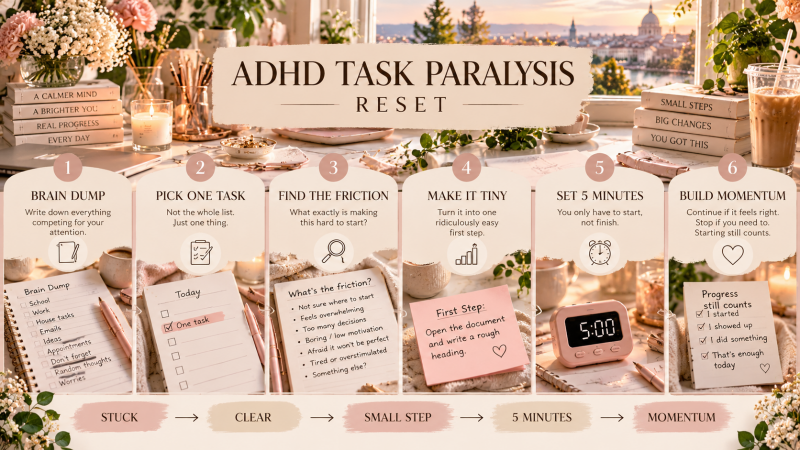
Create a Reset Routine for the Moments When Everything Feels Too Much
The best time to decide what to do during task paralysis is not necessarily when you are already experiencing it. Create a simple reset sequence that you can return to whenever you notice yourself becoming stuck.
You might begin by writing down everything in your head, choosing one task, identifying what makes it difficult, shrinking the first step and setting a five minute timer. You can remove obvious distractions, prepare a drink, put your phone somewhere less accessible and decide what will happen when the timer finishes. The exact routine matters less than having one. When overwhelm appears, you no longer need to invent a solution while overwhelmed. You already have a path back into action.
Your Productivity System Should Reduce Decisions, Not Create More of Them
A planner is only useful if it makes your life easier to navigate. If maintaining your productivity system becomes another complicated responsibility, the system itself can become part of the problem. You do not need seventeen categories, six different apps and an elaborate morning routine to become organized. A simple system that tells you what matters today, what can wait and what the next action is may be far more useful.
This is also why visual planning can work so well for some people. Seeing tasks outside your head makes them easier to evaluate. You can identify what is urgent, notice when your list is unrealistic and break large projects into visible stages. Instead of asking how you can become disciplined enough to follow the perfect system, ask how you can design a system that requires fewer decisions when your energy and attention are limited. That is a very different approach to productivity.
What to Do the Next Time You Cannot Start
The next time you find yourself staring at a task and wondering why you are still not doing it, resist the urge to immediately add more pressure. Look at the task itself. Is the first step clear? Is it too large? Are there hidden decisions? Are you worried about doing it perfectly? Do you know how long you are expected to work? Would writing everything down help? Would a timer, another person or a quieter environment make starting easier?
Then choose one adjustment. You do not need to fix your entire routine before you can begin. You only need to make the next action easier than it was a few minutes ago. Over time, this creates something more valuable than a perfect productivity streak. You begin learning the conditions that help you function well. You notice which tasks need to be broken down, which environments help you focus, when you need external structure and which systems create unnecessary friction.
That knowledge allows you to build routines around how you actually work instead of constantly fighting against an imaginary version of how you think you should work.
Final Thoughts
ADHD task paralysis can make an ordinary task feel enormous, particularly when you are already overwhelmed by everything else competing for your attention. The answer is not always more pressure, a longer to do list or another attempt to wait for the perfect burst of motivation. Sometimes the most effective change is much smaller.
Make the task visible. Find the hidden obstacle. Shrink the first step. Give yourself five minutes. Put distracting thoughts somewhere safe. Make time easier to see. Borrow structure when you need it and create a version of your routine that still works when your energy is low.
Most importantly, remember that productivity is not measured only by how much you finish. A useful system helps you understand what needs your attention, decide what matters and find a realistic way to begin. The next time everything feels stuck, you do not need to solve the entire day. You only need to create a clear enough first step for movement to become possible.
See you in the next edition. ♡
Dayna Ashfort Studio
Create beautifully. Study smarter. Work with intention.
Kommentar hinzufügen
Kommentare