


Homework can feel completely different for a child with ADHD. A worksheet that looks like a simple 20-minute task can quickly become overwhelming when your child does not know where to start, gets distracted halfway through, forgets the instructions or shuts down before the first question is even finished. And often, the solution is not more pressure or longer study sessions. The right ADHD homework strategies can make learning at home feel much more manageable. Small steps, visual instructions, movement breaks, shorter focus sessions and simple problem-solving routines can help children understand what to do next and work more independently. In this guide, you’ll find 12 practical ways to create a calmer homework routine and help your child start, focus and keep going when learning feels difficult.
How to Help a Child With ADHD Focus on Homework: 12 Simple Strategies That Actually Help
Homework can become one of the most frustrating parts of the day for families of children with ADHD. Your child may understand the lesson perfectly in school and still sit in front of a worksheet at home without knowing how to begin. They might sharpen a pencil, ask for a drink, stare at the first question, suddenly remember something they wanted to tell you, lose the instruction they just read and eventually become so frustrated that a small assignment feels impossible.
When this happens repeatedly, it is easy to assume that the problem is motivation. In reality, knowing how to complete an assignment and being able to organize yourself enough to begin, continue and finish that assignment are not always the same thing. Homework asks a child to use several skills at once. They have to remember instructions, ignore distractions, estimate time, decide where to begin, hold information in mind, manage frustration and continue working even when the task is not particularly interesting.
That changes the way we should approach homework. Instead of asking how we can make a child try harder, it is often more useful to ask how we can make the task easier to enter, understand and navigate. The goal is not to create a child who can sit perfectly still at a desk for two hours. The goal is to help your child develop strategies they can eventually use independently when their brain says, “I don't know where to start.”
1. Create a Transition Between School and Homework
One of the easiest mistakes to make is expecting homework to begin immediately after a child gets home. After spending hours listening, following instructions, switching between subjects and navigating a busy classroom, some children need time to transition before they are ready to concentrate again.
A transition does not need to become an entire afternoon of screen time. It can simply create a clear boundary between school and homework. Your child might have a snack, change clothes, spend a little time outside, draw, listen to music or move their body before beginning.
What matters is predictability. If homework starts at a completely different time every day, beginning the task becomes another decision the child has to make. A simple routine can remove that decision. Coming home, having a snack, taking a short reset and then beginning homework creates a sequence the brain can learn to expect. Over time, the routine itself becomes a cue that says it is time to switch into homework mode.
2. Make the First Step Smaller Than the Assignment
When a child is overwhelmed by homework, telling them to “just start” often does not solve the problem because starting is exactly the part they are struggling with. Imagine a worksheet containing twenty math problems. An adult sees twenty small questions. An overwhelmed child may see one enormous task called “math homework.”
Change the size of the task psychologically by changing the instruction. Instead of saying, “Finish your math worksheet,” ask your child to put the worksheet on the desk and find question one. Then ask them to read the first question. Then solve only that question. The assignment has not changed, but the entry point has.
This strategy works particularly well when children tend to avoid tasks before they have even attempted them. The first goal is not necessarily to finish. The first goal is to create movement. Once the pencil is on the paper and one question has been completed, the task often feels different because the child is no longer facing the beginning.
3. Turn Instructions Into Something Your Child Can See
Verbal instructions disappear as soon as they are spoken. A visual instruction remains available. If you frequently find yourself saying, “I already told you what to do,” consider moving some of those instructions out of conversation and onto paper. A homework checklist could say:
-
Read the question carefully.
-
Circle the important information.
-
Decide what you need to find.
-
Choose a strategy.
-
Solve the problem.
-
Check your answer.
Now your child does not need to remember all six steps while simultaneously solving the problem. The checklist holds the sequence for them. This is especially useful for assignments with repeated processes, including math word problems, writing tasks, spelling practice and exam revision. Instead of repeatedly asking an adult what comes next, the child learns to look at the visual guide.
That is an important shift because the real objective is not simply getting tonight's homework finished. You are teaching your child how to navigate a task independently.
4. Stop Measuring Focus by How Long Your Child Can Sit Still
A long homework session is not automatically a productive homework session. A child who spends forty minutes sitting at a desk may only complete ten minutes of meaningful work if the remaining time is spent staring, fidgeting, arguing, searching for supplies or repeatedly returning attention to the task.
Shorter, purposeful focus periods can sometimes work much better. Instead of beginning with “You need to sit here until this is finished,” try creating a manageable work period. Your child works on one clearly defined task for a short amount of time and then takes a brief break before returning. The important part is that the break has a beginning and an end. Getting up, stretching, drinking water, walking around the room or doing a few movements can provide a reset without turning a five minute break into the end of homework for the evening.
You can experiment with the length of the work period because children are different. The useful question is not whether a particular timer method is popular. The useful question is how long your child can currently work effectively before the quality of their attention noticeably declines. Start there and build gradually.
5. Use Movement as a Learning Tool
Learning does not have to look like sitting silently at a desk. Some children think better when they can move. Vocabulary can be practiced while walking around the room. Multiplication facts can be answered while tossing a soft ball. Spelling words can be written on a whiteboard while standing. A child can read a paragraph and then walk across the room before explaining what it meant.
Movement can also be built into the work itself. If your child has ten questions to complete, you might place the worksheet on one side of the room and the answer cards on another. The child solves a problem and then walks over to find the matching answer. The academic objective remains the same, but the learning experience changes.
This can be particularly valuable for parents who have spent months saying, “Sit down,” when sitting down has accidentally become part of the battle. The question becomes whether stillness is actually necessary for the skill your child is practicing. Sometimes it is. Often it is not.
6. Make Time Visible
“Do your homework for twenty minutes” is an abstract instruction. A child may understand what twenty minutes means mathematically without having a strong sense of what twenty minutes feels like while working. Making time visible can help.
A visual timer, a simple clock or a clearly defined amount of work can give the session boundaries. You might say that you are working until the timer finishes, but you can also define the session by the task itself, such as completing three problems before taking a break. This is useful because children who struggle with homework may experience an assignment as if it has no visible ending. Once they can see where the current work period stops, beginning can feel safer.
You can also teach time awareness by making small predictions together. Before beginning, ask how long your child thinks five math problems will take. When they finish, compare the estimate with the actual time. There is no need to turn this into another test. The purpose is simply to help your child develop a more realistic sense of time.
7. Teach Strategies Instead of Only Correcting Answers
When a child gives the wrong answer, our instinct is often to explain the correct answer. Sometimes a more useful question is, “Show me how you tried to solve it.” That question reveals the process. Suppose your child is solving 8 + 5 and becomes stuck. Simply telling them that the answer is 13 solves one problem. Teaching them how to make 10 gives them a strategy they can reuse.
They can break 5 into 2 and 3, add 2 to 8 to make 10, and then add the remaining 3.
Now the child sees:
8 + 5
8 + 2 = 10
10 + 3 = 13
The same principle applies beyond addition. A child struggling with subtraction might use counters or a number line. A child struggling with a word problem might draw the situation. A child struggling with a large assignment might divide it into smaller sections.
The powerful lesson is not “Here is the answer.” It is “Here is something you can try when you do not know the answer.” That is how problem solving begins to become independent.
8. Use Active Learning Instead of Repeated Reading
Reading the same page again and again can feel productive because the material becomes familiar, but familiarity is not necessarily the same as being able to recall information independently. Instead, encourage your child to do something with what they are learning.
After reading a short section, close the book and ask them to explain what they remember. Let them draw the concept. Ask them to teach it to you. Create questions from the material. Write keywords on cards and sort them into groups. Use a blank piece of paper and let your child write everything they remember before checking the textbook.
This changes learning from receiving information to retrieving and using information. It can also make studying more interesting because the child is interacting with the material rather than staring at it. If they cannot remember much at first, that does not mean the strategy failed. The forgotten information shows you exactly what needs another look.
9. Try Body Doubling Without Taking Over
Sometimes a child does not need another explanation. They simply find it easier to stay with a task when another person is nearby. You can sit at the table while your child works and do something quiet of your own. You might answer emails, organize papers, read or plan tomorrow while they complete homework.
Your presence provides structure without turning you into the person doing the assignment. This distinction matters. If every moment of homework depends on a parent saying what to do next, the child can become increasingly dependent on prompts. Instead, try being available without directing every step.
When your child asks, “What do I do now?” you can redirect them toward the system you have created. “What does your checklist say?” “What strategy could you try?” “What is the question asking you to find?” This gives support while returning the thinking to the child.
10. Create a Plan for the Moment Your Child Gets Stuck
One of the most valuable learning tools you can give a child is a plan for what to do when they do not know what to do. Without a strategy, getting stuck can quickly become emotional. The child sees a difficult question, cannot immediately solve it and concludes that they cannot do it.
Instead, teach a repeatable problem solving routine. First, read the problem slowly. Next, identify what you already know. Then decide what you need to find. After that, choose one strategy. You might draw a picture, use counters, use a number line, break the numbers apart, make 10, look for a pattern or solve an easier version of the problem first. Try the strategy and check the result. If it does not work, choose another strategy.
This is where a simple Math Problem Solver worksheet or visual checklist can become far more than another printable. It can act as an external guide when the child cannot remember the process independently. Eventually, the goal is for that external process to become an internal one. Instead of thinking, “I don't know this, so I can't do it,” your child begins to think, “I don't know this yet, so which strategy should I try?” That is a completely different relationship with difficult work.
11. Reduce the Amount of Information Competing for Attention
Sometimes the problem is not the math question. It is everything surrounding the math question. A crowded worksheet, twenty visible questions, colorful supplies, toys on the desk, notifications, conversations and background noise can all compete with the task. Experiment with simplifying what your child sees.
Cover the bottom half of a worksheet with a blank sheet of paper so only a few questions are visible. Keep only the supplies needed for the current task on the desk. Put the phone somewhere else. If background sound helps your child, choose something predictable rather than constantly changing television or video content.
You can even separate subjects physically. Math materials can stay in one folder, reading materials in another and finished homework in a clearly marked place. The objective is not to create a perfectly empty environment. The objective is to remove unnecessary decisions and competing information. Sometimes the most effective homework intervention is surprisingly simple: show the child less at one time.
12. Change What Success Looks Like
Children who repeatedly struggle with homework can begin to associate learning with correction. Wrong answer. Forgot your book. You were not listening. Try again. Focus. Hurry up. Over time, the child may become more concerned about getting something wrong than interested in figuring it out. That is why it is worth noticing the process, not only the result.
If your child gets a question wrong but chooses a strategy independently, that is progress. If they become frustrated but return to the task after a break, that is progress. If they remember to check their work without being reminded, that is progress. If they ask for help before becoming overwhelmed, that is progress too.
This does not mean pretending incorrect answers are correct. Children still need accurate feedback. It means recognizing the skills underneath successful learning. You are not only teaching addition, reading or spelling. You are teaching persistence, self awareness, problem solving and how to recover when something feels difficult. Those skills extend far beyond tonight's worksheet.
Build a Simple ADHD Homework Rescue Routine
You do not need to implement twelve new strategies tomorrow afternoon. In fact, introducing everything at once can create exactly the kind of overwhelm you are trying to reduce. Start with a simple routine your child can learn.
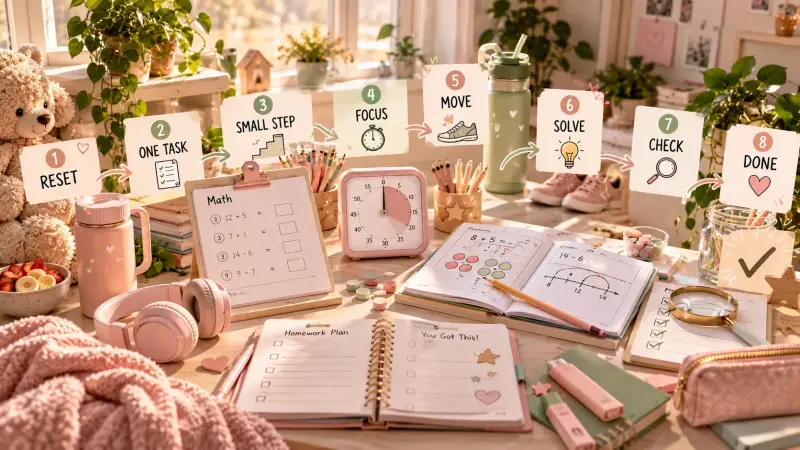
When homework begins, give your child time to transition from school. Choose one task instead of displaying the entire workload. Break that task into a small first step. Decide how long the first focus period will be. Keep a visual strategy nearby. Allow a short movement break when the work period ends. Return for another manageable section and check completed work together.
If your child gets stuck, avoid immediately providing the solution. Ask them what the problem is asking, what information they already have and which strategy they could try. Over time, gradually hand more of that process back to your child. At first, you may be the person saying, “Let's find the first step.” Later, you can ask, “What is your first step?” Eventually, your child may begin without needing the question. That is the real goal.
A Difficult Homework Day Is Information
Not every strategy will work every day. A child who completed homework successfully yesterday may struggle with the same routine today because attention does not exist in isolation. Hunger, tiredness, stress, difficulty of the assignment, changes in routine and emotional overload can all affect how manageable homework feels.
Instead of treating a difficult afternoon as proof that the system has failed, use it as information. Ask what part became difficult. Was beginning the problem hardest? Was the worksheet visually overwhelming? Did your child understand the math but forget the instructions? Was the work period too long? Did they need movement? Was the assignment simply beyond what they currently understand?
The more precisely you identify the obstacle, the more precisely you can choose a solution. That is one of the biggest shifts parents can make when supporting a child with ADHD. Instead of trying to fix “focus” as if it were one single skill, look for the exact point where the learning process is breaking down. Then support that point.
The Goal Is Not Perfect Focus
Your child does not need to become a different kind of learner to become a successful learner. They need tools that help them understand how they learn. A timer can eventually become time awareness. A checklist can eventually become an internal sequence. A number line can eventually become mental calculation. A parent sitting nearby can eventually become independent task initiation. A problem solving sheet can eventually become the quiet thought, “I am stuck, but I know what I can try next.”
That is why the best homework strategies do more than get an assignment finished. They give children a way forward. When homework becomes difficult tomorrow, you do not need to begin with “Why aren't you focusing?” Try a different question. “What is making this hard right now, and what strategy could make the next step easier?”
Sometimes that one change is where independent learning begins.
See you in the next edition. ♡
Dayna Ashfort Studio
Create beautifully. Study smarter. Work with intention.
Kommentar hinzufügen
Kommentare