


Have you ever studied for hours, only to forget everything the next day? You're not alone. Many students struggle to remember what they learn, especially when preparing for exams, managing a busy schedule, or trying to stay focused. The good news? Studying effectively isn't about spending more hours with your books. It's about using smarter study techniques that help your brain understand, remember, and recall information. Whether you're in high school, college, university, or learning something new as an adult, these 7 simple study techniques will help you improve memory retention, build better study habits, and make your study sessions more productive. Let's discover how to study smarter, not harder and actually remember what you learn.
1. Stop Trying to Memorize Everything and Start Understanding It
One of the biggest mistakes students make is believing that learning means remembering every sentence exactly as it appears in a textbook. They read the same paragraph repeatedly, hoping that eventually the words will become permanently stored in their memory. Unfortunately, recognizing familiar words is not the same as understanding what those words mean.
Imagine you are learning about photosynthesis. You could spend twenty minutes memorizing a complicated scientific definition, or you could begin with a much simpler question: How does a plant make its own food?
Suddenly, the concept becomes easier to explore. A plant absorbs sunlight, takes in water through its roots, and uses carbon dioxide from the air to produce glucose, releasing oxygen in the process. Once you understand the basic relationship between these elements, the scientific terminology has something meaningful to connect to.
This approach works far beyond biology. In mathematics, understanding why a formula works makes it easier to recognize when to use it. In history, understanding why an event happened makes dates and consequences easier to connect. Even in subjects that require memorization, building understanding first can make the information easier to organize and remember.
Try this today: Before writing anything in your notebook, ask yourself what the topic is actually trying to explain. Then describe it in your own words as if you were explaining it to someone who has never heard of it before. If your explanation feels complicated, that does not mean you are incapable of learning the subject. It simply shows you which part needs another example or a clearer explanation.
2. Use Active Recall to Make Your Brain Work With Information
There is a reason why something can look completely familiar when you read it but suddenly disappear from your mind during an exam. Reading gives your brain access to the answer, while an exam asks your brain to retrieve that answer without seeing it. This is where active recall, one of the most useful evidence supported study techniques, becomes particularly valuable.
Instead of repeatedly looking at your notes, you deliberately practice remembering the information without them. The process can feel more difficult than rereading, but that difficulty is often part of what makes retrieval practice useful for long term learning.
For example, imagine you have just finished studying a chapter about the human digestive system. Rather than immediately reading the chapter again, close your textbook and take a blank sheet of paper. Write down everything you can remember about how food moves through the body, which organs are involved, and what each organ does.
You will probably remember some details immediately, hesitate over others, and completely forget a few. That is useful information because you have just discovered the difference between what feels familiar and what you can independently recall.
Now reopen your textbook, compare your explanation with the original material, and focus on the information you missed. When you test yourself again later, you are practicing the exact skill you will need during an exam.
You can use active recall with flashcards, practice questions, blank paper, verbal explanations, or even a few questions written at the end of your notes. The goal is not to get every answer right immediately. The goal is to give your memory repeated opportunities to retrieve information, check mistakes, and become more reliable.
3. Make Difficult Topics Easier With the Feynman Technique
Have you ever listened to someone explain a complicated subject so clearly that you suddenly wondered why it seemed difficult in the first place? That feeling is exactly what makes simple explanations so powerful. The Feynman Technique is built around a practical idea: if you want to understand something more deeply, try explaining it in language that another person can easily follow.
Imagine you are studying inflation in economics. Your textbook might contain definitions involving purchasing power, price levels, monetary policy, and consumer demand. Those concepts matter, but trying to remember every technical term before understanding the central idea can make learning unnecessarily complicated.
Instead, you might begin with a familiar situation. Last year, your usual grocery shopping cost $50. This year, buying the same items costs $55. If prices rise while your money stays the same, your money buys less than before. That example does not explain every cause of inflation, but it gives you a starting point that makes the broader concept easier to understand.
Once you can explain the basic idea clearly, you can gradually add more advanced terminology, examples, and exceptions without losing sight of what the subject actually means. You do not need an audience to use this technique. Explain the topic aloud while sitting at your desk, pretend you are teaching a younger student, or write a short explanation using everyday language.
Whenever you reach a point where you cannot explain what happens next, return to your material and investigate that specific gap. The real breakthrough happens when you stop asking whether you recognize an explanation and start asking whether you could create that explanation yourself.
4. Use Spaced Repetition Instead of Starting Over Every Time
Think about how often you have studied something thoroughly on Sunday, forgotten most of it by Wednesday, and then spent another evening learning the same material again. This frustrating cycle happens partly because new information becomes easier to forget when we do not revisit it. One long study session may create a strong feeling of familiarity, but that feeling does not guarantee that the information will remain accessible weeks later.
Spaced repetition offers a more sustainable approach by spreading review sessions across time rather than concentrating all your studying into one exhausting evening. Imagine learning a new topic on Monday. You might briefly test your understanding on Tuesday, revisit it again on Thursday, and complete another recall session the following week. The exact intervals can change depending on the subject, your progress, and your exam date.
What matters is that you return to the information repeatedly and actively try to remember it. A useful review session does not always need to last thirty minutes. Sometimes five focused minutes spent answering a few questions can reveal exactly what you still remember and what needs attention.
You can make this process easier by creating a simple study tracker with the topic, the date you first learned it, and your next planned review. If a topic feels easy, you may be able to increase the time before reviewing it again. If you struggle to recall the information, review it sooner and work through another example.
Over time, this approach can reduce the need to relearn entire chapters because you are maintaining knowledge instead of repeatedly rebuilding it.
5. Turn Complicated Information Into Visual Connections
Sometimes the problem is not that a subject is too difficult. It is that the information is presented in a format that makes the relationships between ideas hard to see.
A textbook can contain several pages explaining a process that becomes much clearer when you draw it as a simple diagram. A historical timeline can reveal connections that feel confusing when buried inside paragraphs. A mathematics problem can suddenly make sense when you visualize what the numbers represent.
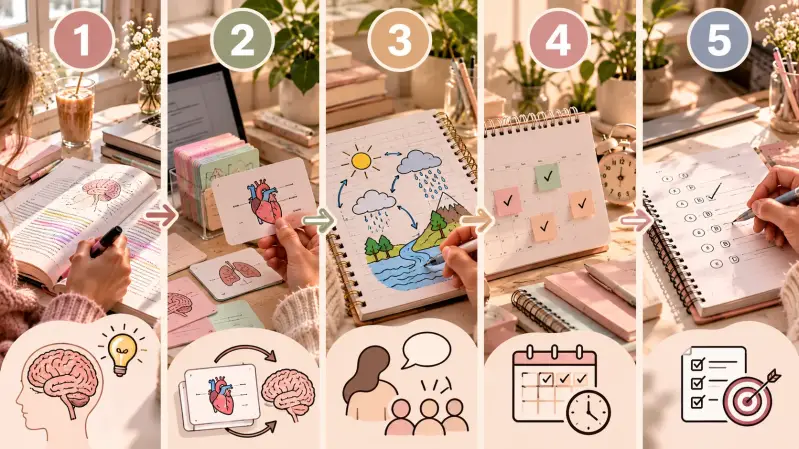
Visual learning techniques can be especially helpful when the topic involves sequences, comparisons, categories, or relationships. For example, imagine studying the water cycle. Instead of memorizing a list of unfamiliar terms, draw a small landscape with the sun, ocean, clouds, mountains, and rain. Add arrows showing how water evaporates, condenses, falls as precipitation, and returns through collection and runoff.
Now the information has a structure. You can see how one stage leads to another, and you have created a visual explanation that you can use during recall practice. The same principle works for grammar rules, scientific processes, financial concepts, business models, and exam preparation.
You can create mind maps, flowcharts, comparison tables, timelines, or simple sketches. The purpose is not to produce beautiful notes or spend an hour decorating a page. The best study visual is the one that makes a confusing idea easier to understand in seconds.
Keep your diagrams simple, label the important relationships, and challenge yourself to recreate them without looking at the original. That final step matters because drawing something from memory turns a visual aid into an active learning exercise.
6. Study in Small, Focused Sessions That Have a Clear Purpose
One of the most discouraging study habits is sitting down with an enormous goal such as studying biology, revising mathematics, or preparing for finals. Those goals sound productive, but they give your brain very little direction. When a task feels too large, it becomes easier to procrastinate, switch between subjects, or spend time organizing materials without actually learning anything.
A more effective approach is to make each study session small enough to begin immediately and specific enough to measure. Instead of planning to study chemistry for two hours, decide that you will spend the next twenty minutes understanding how ionic bonds form and solving three related questions.
Instead of trying to revise an entire history chapter, focus on explaining the three main causes of a particular event and checking whether you can remember them without notes. This approach can be especially useful when you struggle with attention, motivation, or feeling overwhelmed by large assignments. It does not remove every concentration challenge, but it makes the next action clearer and more manageable.
You might begin with twenty minutes of focused studying followed by a short break, adjusting the duration to suit your attention and energy. During that time, keep only the materials you need in front of you and give yourself one specific learning objective.
At the end of the session, ask yourself whether you can do something you could not do before. Can you solve the problem independently? Can you explain the concept? Can you answer a question without checking your notes? These questions provide a much more meaningful measure of progress than simply counting how long you sat at your desk. Remember that a short session with genuine understanding can be more valuable than a long session filled with distractions and passive reading.
7. Test What You Know Before You Decide You Are Finished
There is a moment during studying when everything suddenly feels familiar. You recognize the definitions, understand the examples, and feel confident that you have mastered the topic. But confidence and accurate recall are not always the same thing.
The final step in effective studying is to check whether you can use what you have learned independently, especially when the question looks different from the examples you practiced. Imagine learning how to calculate percentages. You might understand a worked example showing how to find 20 percent of $100. But can you calculate a 15 percent discount on a $68 purchase without copying the original method step by step?
That second question reveals whether you understand how to apply the concept in a new situation. This is sometimes called transfer of learning, and it is an important part of developing knowledge that remains useful beyond a particular worksheet or textbook example. Before finishing a study session, create a small challenge for yourself. Answer three questions without notes, solve a slightly different problem, compare two related concepts, or explain how the topic connects to something you already understand.
If you make a mistake, investigate why it happened. Perhaps you misunderstood a definition, skipped a step, or remembered a rule without understanding when it applies. Correcting these mistakes is part of learning, not evidence that your studying has failed. The goal is to move from recognizing information to being able to retrieve, explain, and apply it. And that is where real confidence begins.
How to Combine These 7 Study Techniques Into One Simple Routine
You do not need seven different notebooks, an elaborate productivity system, or a complicated study schedule to use these techniques. In fact, the most useful study routine is often one that feels simple enough to repeat on an ordinary busy day. Imagine you have thirty minutes to study a topic you find difficult.
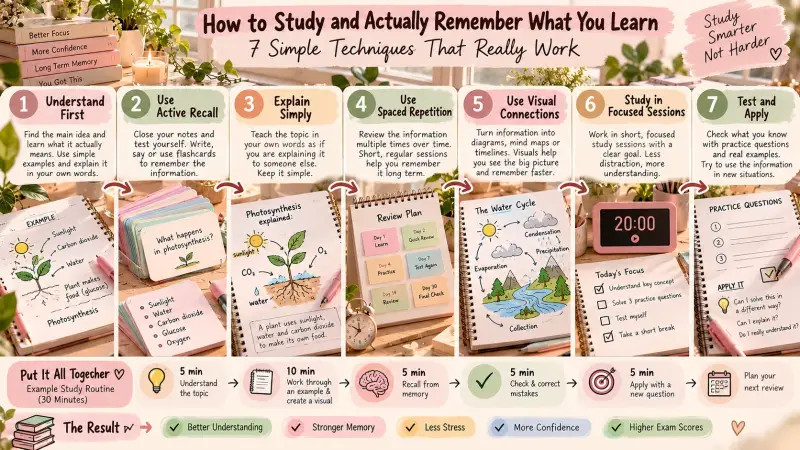
Begin by spending five minutes identifying the central idea and finding a clear explanation. Use the next ten minutes to work through an example, create a simple diagram if it helps, and explain the concept in your own words. Then close your materials and spend five minutes recalling the most important information. Use another five minutes to check your answers and correct any misunderstandings. Finally, spend the last five minutes completing a new question that requires you to apply what you have learned.
Before you finish, decide when you will briefly review the topic again. This is only an example, not a rigid formula. Some subjects require longer practice, some concepts take more time to understand, and some days you may need shorter sessions. What makes the routine valuable is that every stage has a purpose. You understand the information, work with it, retrieve it, check it, and return to it later.
Instead of asking yourself how many hours you should study, you begin asking a more useful question: What can I understand and do independently by the end of this session? That small change in perspective can transform the way you approach learning.
Why Studying Smarter Matters More Than Studying Longer
Somewhere along the way, studying became associated with exhaustion. We started treating long hours, overflowing notebooks, and endless revision sessions as proof that we were working hard enough. But learning is not a competition to see who can spend the most time staring at a textbook.
Of course, developing expertise requires effort, practice, and consistency. Difficult subjects cannot always be mastered in a few minutes, and there is no single technique that works equally well for every person or every learning task. Yet there is a meaningful difference between spending time productively and spending time repeating activities that create the feeling of studying without building reliable understanding.
When you learn to recognize that difference, you gain something more valuable than a perfectly organized study schedule. You gain a clearer sense of control over your own learning. You begin to notice which concepts you understand, which ones need another explanation, and which study methods actually help you remember information. Instead of feeling defeated when you forget something, you know how to return to it, practice retrieval, and strengthen your understanding.
And perhaps most importantly, you no longer have to measure your ability by how quickly someone else seems to learn. Your progress becomes something you can observe, practice, and improve.
Your Next Study Session Can Be Different
The next time you open your textbook, resist the urge to immediately highlight everything or copy another page of notes. Choose one concept. Find out what it really means. Connect it to something familiar. Explain it in your own words. Close your materials and see what you can remember.
Then challenge yourself to use that knowledge in a new example. You may not remember everything the first time, and that is perfectly normal. Learning is a process of building understanding, retrieving information, identifying gaps, and strengthening connections through practice. But every time you move beyond simply reading information and begin actively working with it, you are giving yourself a better opportunity to learn.
You do not need to become a completely different student to improve the way you study. You need a learning process that helps you turn effort into understanding. And sometimes, that begins with something as simple as closing your textbook and asking yourself one question:
Can I actually explain what I just learned? If the answer is yes, you have made meaningful progress. If the answer is not yet, you know exactly where to begin.
Make Learning Simpler With Dayna Ashfort Studio
At Dayna Ashfort Studio, we believe learning should feel clear, approachable, and purposeful. Whether you are preparing for exams, developing better study habits, or helping someone understand a difficult concept, the right tools can make the process more manageable.
Explore our Free Printable Library for study resources, printable planners, and practical learning tools designed to help you organize your goals and make your next study session more intentional.
Explore the Free Printable Library
Because studying smarter is not about doing more. It is about making what you do truly count.
See you in the next edition. ♡
Dayna Ashfort Studio
Create beautifully. Study smarter. Work with intention.
Kommentar hinzufügen
Kommentare